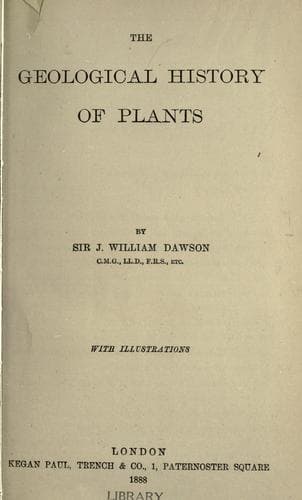
The Geological History of PlantsDawson, John William, Sir
Science
The Geological History of Plants
Dawson, John William, Sir
Paleobotany
Let us now consider the history of the vegetable kingdom as indicated in
the few notes in the right-hand column of the table.
The most general subdivision of plants is into the two great series of
Cryptogams, or those which have no manifest flowers, and produce minute
spores instead of seeds; and Phænogams, or those which possess flowers
and produce seeds containing an embryo of the future plant.
The Cryptogams may be subdivided into the following three groups:
1. _Thallogens_, cellular plants not distinctly distinguishable into stem
and leaf. These are the Fungi, the Lichens, and the Algæ, or sea-weeds.
2. _Anogens_, having stem and foliage, but wholly cellular. These are the
Mosses and Liverworts.
3. Acrogens, which have long tubular fibres as well as cells in
their composition, and thus have the capacity of attaining a more
considerable magnitude. These are the Ferns (_Filices_), the Mare's-tails
(_Equisetaceæ_), and the Club-mosses (_Lycopodiaceæ_), and a curious
little group of aquatic plants called Rhizocarps (_Rhizocarpeæ_).
The Phænogams are all vascular, but they differ much in the simplicity
or complexity of their flowers or seeds. On this ground they admit of a
twofold division:
1. _Gymnosperms_, or those which bear naked seeds not enclosed in fruits.
They are the Pines and their allies, and the Cycads.
2. _Angiosperms_, which produce true fruits enclosing the seeds. In this
group there are two well-marked subdivisions differing in the structure
of the seed and stem. They are the _Endogens_, or inside growers, with
seeds having one seed-leaf only, as the grasses and the palms; and
the _Exogens_, having outside-growing woody stems, and seeds with two
seed-leaves. Most of the ordinary forest-trees of temperate climates
belong to this group.
On referring to the geological table, it will be seen that there is a
certain rough correspondence between the order of rank of plants and the
order of their appearance in time. The oldest plants that we certainly
know are Algæ, and with these there are plants apparently with the
structures of Thallophytes but the habit of trees, and which, for want
of a better name, I may call _Protogens_. Plants akin to the Rhizocarps
also appear very early. Next in order we find forests in which gigantic
Ferns and Lycopods and Mare's-tails predominate, and are associated
with pines. Succeeding these we have a reign of Gymnosperms, and in the
later formations we find the higher Phænogams dominant. Thus there is an
advance in elevation and complexity along with the advance in geological
time, but connected with the remarkable fact that in earlier times low
groups attain to an elevation unexampled in later times, when their
places are occupied with plants of higher type.
It is this historical development that we have to trace in the following
pages, and it will be the most simple and at the same time the most
instructive method to consider it in the order of time.
CHAPTER II.
Public-domain text, read in full here on John Shaqi.
Reviews
Reviews
No reviews yet
Be the first to share your thoughts on this work.
Join the Discussion
Join the discussion
Sign in to leave a comment or review.
Sign InorCreate an account