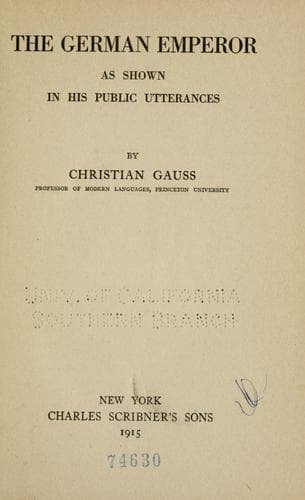
The German Emperor as Shown in His Public UtterancesWilliam II, German Emperor
History
The German Emperor as Shown in His Public Utterances
William II, German Emperor
Germany -- History -- William II, 1888-1918 -- Sources; Germany -- Politics And Government -- 1871-1918
[36] "Emperor William, one of the most comical persons of our
time, orator, poet, musician, dramatic writer, and artist,
and, above all, patriot, has lately painted a picture
representing all the nations of Europe with swords, standing
at the seashore and, at the indication of Archangel Michael,
looking at the sitting figures of Buddha and Confucius in the
distance. According to William's intention, this should mean
that the nations of Europe ought to unite in order to defend
themselves against the peril which is proceeding from there.
He is quite right from his coarse, pagan, patriotic point of
view, which is eighteen hundred years behind the times. The
European nations, forgetting Christ, have in the name of their
patriotism more and more irritated these peaceful nations and
have taught them patriotism and war, and have now irritated
them so much that, indeed, if Japan and China will as fully
forget the teachings of Buddha and of Confucius as we have
forgotten the teachings of Christ, they will soon learn the
art of killing people (they learn these things quickly, as
Japan has proved), and, being fearless, agile, strong, and
populous, they will inevitably very soon make of the countries
of Europe, if Europe does not invent something stronger than
guns and Edison's inventions, what the countries of Europe
are making of Africa. 'The disciple is not above his master:
but every one that is perfect shall be as his master' (Luke
6:40)."--TOLSTOI.
It is a curious fact that for all the Emperor's insistence upon
what might be called nationalism, in artistic matters at least,
in poetry, sculpture, and the drama, he has very little sympathy
with the modern German tendencies. Klinger and Stuck, Ludwig von
Hofmann and Thoma have found no favor, and no attention was paid to
Böcklin. His literary preferences will become more evident after a
reading of his talk with Ganghofer (November 12, 1906).
Public-domain text, read in full here on John Shaqi.
Reviews
Reviews
No reviews yet
Be the first to share your thoughts on this work.
Elsewhere in the archive
Join the Discussion
Join the discussion
Sign in to leave a comment or review.
Sign InorCreate an account