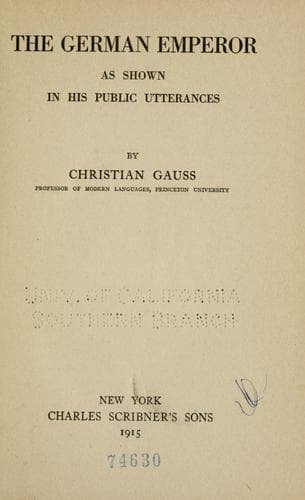
The German Emperor as Shown in His Public UtterancesWilliam II, German Emperor
History
The German Emperor as Shown in His Public Utterances
William II, German Emperor
Germany -- History -- William II, 1888-1918 -- Sources; Germany -- Politics And Government -- 1871-1918
In the matter of sculpture, the achievement in which the Emperor
takes most pride is undoubtedly the famous Siegesallee in Berlin.
It consists of a number of monumental, heroic figures taken from
the history of his house. The avenue, the general scheme, and the
arrangement of many of the figures were planned by him, and the
figures were chosen in consultation with his historiographer. The
style is supposedly classic; there are many incidental animal
figures, and a sphinx and the sibyl help to represent Bismarck. The
attempt to make heroic and classic certain of the fairly mediocre
representatives of his line, like Albrecht, Otto and John, Joachim,
Frederick, and George William, seems to have been too difficult
a task even for that Berlin school of sculpture, which the
Emperor feels would bear comparison with that of the Renaissance.
Notwithstanding his own efforts to awaken art "from the cold sleep
of unculture," it is perhaps significant that powerful, independent
personalities, Michelangelos in sculpture and Bismarcks in
politics, do not seem to thrive under the Emperor's protection.
This eighteenth day of December has a certain significance in the
history of our art here in Berlin, from the fact that that revered
protector of the Muses, my late father, and my mother, who was so
gifted in the arts, dedicated on that day, fifteen years ago, the
Anthropological Museum. This was in a way the last great closing act
which my father accomplished in this direction, and I look upon it as a
special piece of good fortune that it is on precisely this day of the
year that the works for the Siegesallee could be completed.
I seize with joy the opportunity to express to you all, first, my
congratulations and, secondly, my thanks for the way and manner
in which you have helped me to carry out my original plan. The
accomplishment of the programme for the Siegesallee has required a
number of years, and it was the able historiographer of my house,
Professor Doctor Koser, who put me in a position to assign to the
gentlemen the tasks which it was possible for them to carry out.
Once we had found the historical basis, it was possible to go ahead;
and after the choice of the princes was decided upon, then the most
competent men in the way of historical research were found to help the
gentlemen in their work. In this way the groups were conceived, and,
conditioned to a certain degree by history, they gradually took form.
After this part of the work was done, then, naturally, came the
hardest question of all: Would it be possible, as I hoped, to find
enough artists in Berlin who would be in a position to give themselves
entirely to the execution of this programme?
Public-domain text, read in full here on John Shaqi.
Reviews
Reviews
No reviews yet
Be the first to share your thoughts on this work.
Elsewhere in the archive
Join the Discussion
Join the discussion
Sign in to leave a comment or review.
Sign InorCreate an account