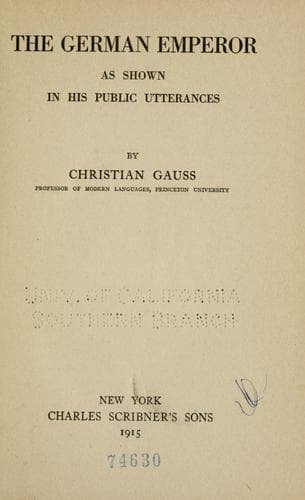
The German Emperor as Shown in His Public UtterancesWilliam II, German Emperor
History
The German Emperor as Shown in His Public Utterances
William II, German Emperor
Germany -- History -- William II, 1888-1918 -- Sources; Germany -- Politics And Government -- 1871-1918
I may now confide something to you. The impression which the
Siegesallee makes upon foreigners is quite overwhelming; everywhere
an immense respect for German sculpture is noticeable. May you remain
standing upon these heights; may also my children and my grandchildren,
if they shall one day be granted to me, keep the same masters by their
side! Then, I am convinced, our people will be in a position to love
the beautiful and to hold high the ideal.
I raise my glass and drink to the health of all of you; and, once more,
my heartiest thanks.
MONUMENT TO GENERAL VON ROSENBERG
APRIL 20, 1902
A monument was erected to the famous cavalry general Von Rosenberg,
in Hanover. After the unveiling of the monument the Emperor
responded to Count von Waldersee's toast as follows:
To-day I greet all the cavalry of the German army. Even from his grave
the general's personality has issued so magic and so powerful an appeal
that it has called the horsemen together from all quarters of the
German Empire and from the contingents of my affiliated rulers, so that
to-day for the first time our German cavalry is gathered together in a
single great cohort.
We wish to draw a lesson from this day. As the general recognized only
his service and the call of duty, may we do likewise! The highest
reward that can come to an officer through his service in life is to
fill his position to his own complete satisfaction. Looking back over
the life of General von Rosenberg, we can compose a proverb which
should apply to us also, now and for all time: "Know your aim, and then
exert every effort." Let that be the standard for our cavalry!
So may we also create for ourselves from this simple monument a symbol
and an example. A block of granite from the mark bears the features of
the general inlaid in bronze; so may we hedge and protect that piece of
granite of our army which we call the cavalry and allow it to harden,
so that he who bites upon it may lose his teeth![37]
[37] A phrase of Frederick the Great which Count Bülow had used in the
Reichstag January 8, 1902, in speaking of the English Colonial
Secretary Chamberlain's attack on the German army.
With this wish I raise my glass and drink to the memory of the general,
to the German cavalry, and to its most conspicuous representative, the
General Field-Marshal, Count von Waldersee. Hurrah!
THE OLD ORDER CHANGETH
AIX, JUNE 19, 1902
The Emperor, accepting an invitation from the city, came to Aix
with the Empress and the Crown Prince. It was here that Charlemagne
was probably born and here that he died. The present Rathaus was
built upon the ruins of his palace, and it was in the so-called
Coronation Room that the Emperor delivered his address.
Public-domain text, read in full here on John Shaqi.
Reviews
Reviews
No reviews yet
Be the first to share your thoughts on this work.
Elsewhere in the archive
Join the Discussion
Join the discussion
Sign in to leave a comment or review.
Sign InorCreate an account