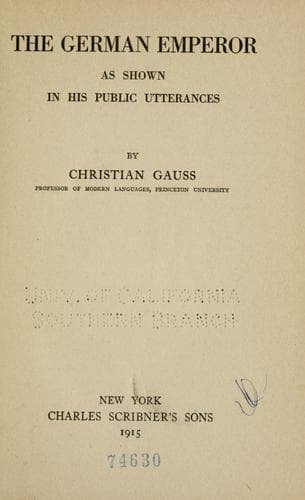
The German Emperor as Shown in His Public UtterancesWilliam II, German Emperor
History
The German Emperor as Shown in His Public Utterances
William II, German Emperor
Germany -- History -- William II, 1888-1918 -- Sources; Germany -- Politics And Government -- 1871-1918
An art which oversteps the laws and boundaries which I have indicated
is no longer art; it is factory work, it is trade; and that no art dare
become. Through the much-misused word "freedom" and under her flag
one often falls into indefiniteness, boundlessness, conceit. However,
he who cuts loose from the law of beauty and from the feeling for
æsthetics and harmony which, whether he can express it or not, every
man feels in his heart; he who thinks the chief thing is to turn his
thoughts in a certain direction toward a definite solution of more
technical problems, sins against the very sources of his art.
Furthermore, art must help to educate the people; it must also give the
lower classes, after their cramping exertions, the opportunity to right
themselves again through ideals. To us, the German people, great ideals
are a lasting possession, while with other peoples they have been more
or less lost. It is now the German people whose special province it
is to protect these great ideas, to foster them, to set them forth;
and to these ideas belongs the duty of giving to those classes who
tire themselves out through labor the opportunity to raise themselves
through beautiful things and to work themselves out of and above their
ordinary circles of thought.
If, however, art, as often happens nowadays, does nothing more than to
make misery even more hideous than it already is, then it sins against
the German people. The fostering of the ideal is the greatest work
of culture; and if we wish to be and to remain a pattern in this for
other peoples, then we must all work together; and if culture is to
accomplish its full task, then it must penetrate through to the very
lowest strata of the people. That it can only do if art lends a hand,
if it raises up instead of drawing down into the gutter.
As ruler, I often feel very bitter that art, through her masters,
should not be energetic enough to make a stand against such tendencies.
I do not doubt for a moment but that many an earnest but misguided
character, perhaps filled with the best intentions, is to be found
among the devotees of this tendency. The real artist needs no
advertising, no press, no connections. I do not believe that your great
examples in the realm of science, either in ancient Greece or in Italy
or in the time of the Renaissance, used any such methods as are now
often practised through the press to bring their ideas especially into
the foreground. They worked as God directed them; for the rest they
allowed the world to criticise.
And that is the way an honorable, sincere artist must act. Art which
stoops to advertising is no longer art, were it praised to the skies.
Every one, be he never so simple, has a feeling for that which is
beautiful or ugly, and it is to foster this feeling further among
the people that I have need of all of you; and that you should have
accomplished such a piece of work in the Siegesallee, I, therefore,
thank you particularly.
Public-domain text, read in full here on John Shaqi.
Reviews
Reviews
No reviews yet
Be the first to share your thoughts on this work.
Elsewhere in the archive
Join the Discussion
Join the discussion
Sign in to leave a comment or review.
Sign InorCreate an account