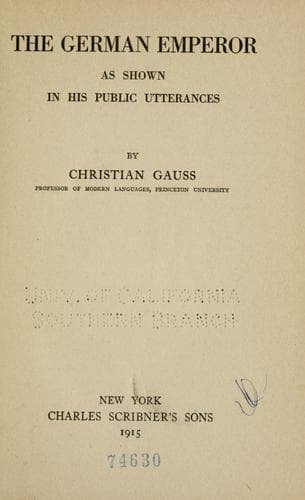
The German Emperor as Shown in His Public UtterancesWilliam II, German Emperor
History
The German Emperor as Shown in His Public Utterances
William II, German Emperor
Germany -- History -- William II, 1888-1918 -- Sources; Germany -- Politics And Government -- 1871-1918
During an evening meeting among ourselves Professor Delitzsch had the
opportunity, with her Majesty, the Empress, and General Superintendent
Dryander, to confer and discuss thoroughly for several hours, during
which I remained a passive listener. He, unfortunately, departed from
the standpoint of the thoroughgoing historian and Assyriologist and
penetrated into the region of theological and religious conclusions and
hypotheses, which were hazy and bold. When, however, he came to the
New Testament it soon became evident that I could not agree with him
in the ideas which he developed concerning the person of the Redeemer,
and I was compelled to state my own standpoint, which was diametrically
opposed to his. He does not recognize the divinity of Christ and
therefore concludes in regard to the Old Testament that it does not
refer to Him as the Messiah. Here the Assyriologist and investigating
historian ceases and the theologian with all his lights and shades
steps in. In this province I can only advise him to go very carefully,
step by step, and in any case to ventilate his theories only in
theological publications and in the circles of his colleagues and to
spare us laymen and especially the Oriental Society, before whose forum
all this is out of place. We excavate and read whatever we find and
publish it for the advancement of knowledge and history, but not in
order to help justify or combat the religious hypotheses of any one of
many learned men.
In Delitzsch's case the theologian has run away with the historian,
and the latter serves merely as a point of departure for the former.
I think it unfortunate that Delitzsch should not have stuck to his
original programme, which he developed in former years, namely, on
the basis of the discoveries of our society, to ascertain through
scientifically approved translations of the Scriptures how far these
offer an illustration of the chronicle of the people of Israel;
that is, enlightenment as to historical events, customs, and uses,
traditions, politics, legislation, etc.; in other words, how far the
undeniably highly developed Babylonian culture came into contact with
the Israelites, could work upon them, yes, even impress its stamp upon
them, and thereby accomplish, from a purely human point of view, a
sort of rehabilitation for the Babylonians, who were, according to the
Old Testament at least, a very crude, shameful, and one-sided people.
That was his original intention, at least as I understood it, and a
province very fruitful and interesting to us all, the investigation,
explanation, and exposition of which must have interested us laymen to
the highest degree and would have demanded our deepest gratitude. But
he should have stuck to this. Unfortunately, however, in his zeal he
has overshot the mark. As was to be expected, the excavations brought
to light communications which bear in a religious way upon the Old
Testament. He should have collated this material and pointed out and
Public-domain text, read in full here on John Shaqi.
Reviews
Reviews
No reviews yet
Be the first to share your thoughts on this work.
Elsewhere in the archive
Join the Discussion
Join the discussion
Sign in to leave a comment or review.
Sign InorCreate an account