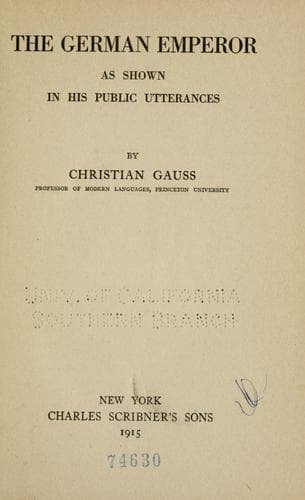
The German Emperor as Shown in His Public UtterancesWilliam II, German Emperor
History
The German Emperor as Shown in His Public Utterances
William II, German Emperor
Germany -- History -- William II, 1888-1918 -- Sources; Germany -- Politics And Government -- 1871-1918
explained coincidences, when such occurred, but he should have left it
to the listener to draw for himself all purely religious conclusions.
In this way his discourse would have commanded the interest and
good-will of the lay public. That, unfortunately, he has not done.
Pretending that he could explain it all on historical and purely human
grounds, he has attacked the question of revelation in a very polemical
manner and more or less denied it. That was a serious mistake, because
he touched many of his hearers in what was deepest and most sacred to
them. And whether he was right or wrong--that for the moment is all
one, since we are concerned not with a purely scientific gathering
of theologians but with laymen of all kinds and conditions--he has
overturned and rudely shaken many favorite conceptions and images
with which these people connect sacred and cherished ideas and has
ruthlessly shaken the foundation of their belief, if he has not swept
it away altogether, a thing which only a mighty genius dare be bold
enough to undertake and which the study of Assyriology alone does
not justify. Goethe also once treated this subject and pointed out
especially that one must be careful before a great, general public to
break down only "_Terminologiepagoden_" [the pagodas of terminology].
The excellent professor, in his zeal, has overlooked the principle that
it is very necessary to distinguish between what is and what is not
fitting to the place, the public, etc. As a theological specialist he
can, through the avenue of special publications, express for his circle
of colleagues his theses, hypotheses, and theories as well as his
convictions, which it would not do to express in a popular lecture or
book.
I would like now to come back once more to my own personal standpoint
in regard to the doctrine or view of revelation, as I have often
explained it to you, my dear Hollmann, and to other gentlemen. I
distinguish between two different kinds of revelation: one a continuous
and in a manner historical revelation; the other a purely religious
one, preparing for the later appearance of the Messiah.
Public-domain text, read in full here on John Shaqi.
Reviews
Reviews
No reviews yet
Be the first to share your thoughts on this work.
Elsewhere in the archive
Join the Discussion
Join the discussion
Sign in to leave a comment or review.
Sign InorCreate an account