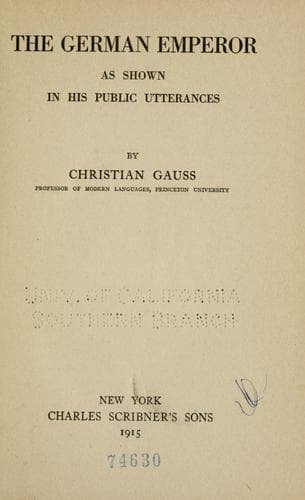
The German Emperor as Shown in His Public UtterancesWilliam II, German Emperor
History
The German Emperor as Shown in His Public Utterances
William II, German Emperor
Germany -- History -- William II, 1888-1918 -- Sources; Germany -- Politics And Government -- 1871-1918
One hundred and fifty years ago, on these same fields, his Majesty,
Frederick II, who even in his lifetime was called "the Great," gathered
together a considerable part of his army in order to train and steel
it for the mighty struggles which he foresaw in spirit through his
prophetic vision. So important was this preparation for him that he did
not hesitate to trust his columns to the direction of his experienced
field-marshals. Here the great soldier King, working restlessly,
not overlooking details in his interest for the greater concerns of
history, trained his regiments for the difficult tasks of the Seven
Years' War, which was soon to set in, and created that inner bond
between himself and his soldiers which inspired them to the greatest
deeds of daring, while he infused his spirit into his generals and
so laid the foundation for the unmatched results which found their
crowning achievement in the victorious overthrow of a world in arms
united against him. Let these achievements be unforgotten; unforgotten
the names of the heroes of that great time.
Frederick's enemies derisively called his little army the "_Potsdamer
Wachtparade_" [the "Potsdam Guard's Parade"]! Well, he showed them what
he could do at the head of it! And in later times likewise the "Potsdam
Guard's Parade" fittingly showed the way to every one who tried to
cultivate too close an acquaintance with it. This obelisk of northern
granite is erected in memory of that time. A memorial to "Fredericus
Rex, the King and Hero," to be emulated by us all in working with
unabated strength to the end that we may be ready to strike in any
emergency. When in a moment the curtain shall fall, when the flags
and standards dip in greeting, swords are lowered, and presented
bayonets glisten--all this is done in honor not only of this block of
stone but of him, the great King, his generals and field-marshals;
of his great successor, William the Great, and his paladins, who now,
assembled around the Great Ally above, look down upon us; and in honor
of Prussia's glorious martial history and tradition. Attention, present
arms!
THE FUTURE OF GERMANY
HAMBURG, JUNE 20, 1903
The equestrian statue of Emperor William I was dedicated in
Hamburg, June 20, 1903. The Emperor's interest in glorifying and
occasionally even in sanctifying his ancestors is frequently
noticeable. He has tried to assure to his grandfather the title
of William the Great, and the Emperor's friend Ballin, of the
Hamburg-American Line, has given this title as well as that of
Imperator to the well-known transatlantic steamers. It is perhaps
significant that Bismarck is not mentioned. The pedestal of this
monument was left blank. As has been noted, rumor has it that the
citizens of Hamburg were unwilling to bestow this title and feared
to offend with the simpler "William I."
Public-domain text, read in full here on John Shaqi.
Reviews
Reviews
No reviews yet
Be the first to share your thoughts on this work.
Elsewhere in the archive
Join the Discussion
Join the discussion
Sign in to leave a comment or review.
Sign InorCreate an account