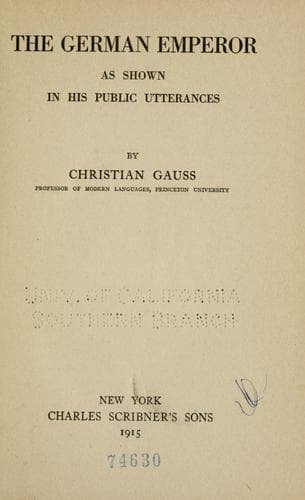
The German Emperor as Shown in His Public UtterancesWilliam II, German Emperor
History
The German Emperor as Shown in His Public Utterances
William II, German Emperor
Germany -- History -- William II, 1888-1918 -- Sources; Germany -- Politics And Government -- 1871-1918
It has often been my task to express my thanks to great cities and
their enthusiastic citizens; never have I found it so difficult to find
the correct, pertinent, and adequate expression for what I feel and
what I have seen and experienced.
If, first of all, I may speak as grandson of the great Emperor, whose
bronze likeness the city of Hamburg has just unveiled, I would like
to give utterance to the gratitude which so stirs my heart, that the
citizens of Hamburg have been able in such a brilliant, handsome, and
noble manner to show their feeling for Germany and their gratitude to
the old hero. As his grandson, this has pleased me greatly and has
stirred me deeply.
For the rest, I cannot forbear to emphasize the truly overwhelming
reception which was accorded me here by great and small, young and old,
high and low. The many thousand faces which lighted toward me to-day
gave evidence that the greeting came from the heart and from feelings
which were deeply moved, and I beg the senate and the citizens to
accept my heartiest, sincerest, and warmest thanks and to communicate
them to the city.
Indeed, for the younger generation which stood with us about the bronze
portrait to-day the great Emperor is already a historical personage,
and the events which weave themselves about his person and the time in
which he worked are already described in history.
I believe that I am not presuming if I prophesy that some time in
future centuries the awe-inspiring figure of my grandfather will stand
forth before the German people, surrounded by at least as many legends
and as powerful and as conspicuous for all time as once the figure of
the Emperor Barbarossa was. Truly, the younger generation is accustomed
to look upon what we call the empire, together with what it has brought
us, without thinking what it has cost to arrive at this point.
And I believe we recognize the hand of Providence when we look upon
that awe-inspiring figure which stands yonder in its peaceful attitude
before the Rathaus, with its earnestness and its silent tranquillity
of old age. It was precisely, this man whom Providence sought out to
accomplish this hardest of all tasks--the uniting of the German races.
For no one could resist the charm of the personality, the simple
modesty, the winning lovableness of the lofty ruler; and so it was
permitted to him, surrounded by his powerful paladins who were devoted
to him and who worked with him, to smooth the way and reconcile the
differences; while he kept ever before his eyes the goal, the union of
the Fatherland. During a long time of peace, in quiet work his thoughts
ripened and the plans of the already gray-haired man were ready when
the mighty task came to him of once more reviving the empire. I hope
that the youth of Hamburg, when they pass this monument, will never
forget the time of preparation through which this noble ruler lived.
Public-domain text, read in full here on John Shaqi.
Reviews
Reviews
No reviews yet
Be the first to share your thoughts on this work.
Elsewhere in the archive
Join the Discussion
Join the discussion
Sign in to leave a comment or review.
Sign InorCreate an account