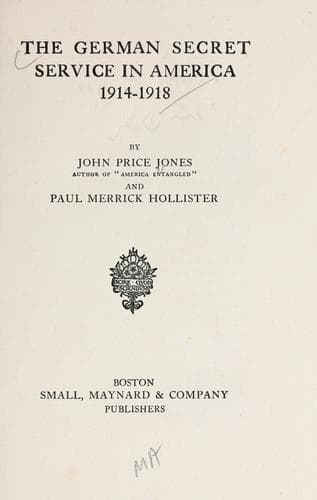
The German Secret Service in America 1914-1918Jones, John Price
History
The German Secret Service in America 1914-1918
Jones, John Price
World War, 1914-1918 -- Secret service -- Germany
"5. The President, in order to ascertain from Mr. M. P. how strong the
German influence of this syndicate is, would like to have the trend
of the German note before the note is officially sent, and declares
himself ready, before the answer is drafted, to discuss it with M. P.,
and eventually to so influence it that there will be an agreement for
its reception, and also to be ready to influence the press through a
wink.
"6. As far as the note itself is concerned, which he awaits, so he
awaits another expression of regret, which was not followed in the last
note. Regret together with the statement that nobody had expected that
human lives would be lost and that the ship would sink so quickly.
"7. The President is said to have openly declared that he could hardly
hope for a positive statement that the submarine warfare would be
discontinued."
Dr. Albert conferred with Captains Boy-Ed and von Papen on all military
and naval matters having a commercial phase. Captain von Papen, on July
7, 1915, submitted to Dr. Albert a memorandum for his consideration and
further recommendation, headed "Steps Taken to Prevent the Exportation
of Liquid Chlorine." He told of the efforts made by England and France
to buy that chemical in America, estimated the output here, and cited
the manufacturers. He also enclosed a plan for checkmating the Allies
and concluded with the following paragraph:
"It will be impossible, however, for this to go on any length of time,
as the shareholders wish the profits to be derived therefrom. Dr.
Orenstein therefore suggests that an agreement be consummated with the
Electro Bleaching Company, through the President, Kingsley, whereby the
delivery of liquid chlorine by this country to France and England will
be stopped. A suggested plan is enclosed herewith.
"From a military standpoint I deem it very desirable to consummate such
an agreement, in order to stop thereby the further exportation of about
fifty-two tons of liquid chlorine monthly, especially in view of the
fact that in France there is only one factory (Rouen) which can produce
this stuff in small amounts, while it is only produced in very small
quantities, in England."
During 1914 and 1915 German speculation in wool was active. Early
in the war von Bernstorff summoned a German-American wool merchant
recommended by a business friend in Berlin and directed him to buy all
the wool he could secure. He did so, using Deutsches Bank credits for
the purchases made for Germany, and making his purchases of wool for
Germany even in Cape Town and Australia. The German-American, after
following this practice for some months, decided that his financial
allegiance belonged to America, so he tried, through Hugo Schmidt, to
induce the German interests in his firm to sell out to him. On August
9, 1915, Schmidt wrote to Keswig, the Berlin principal:
Public-domain text, read in full here on John Shaqi.
Reviews
Reviews
No reviews yet
Be the first to share your thoughts on this work.
Elsewhere in the archive
Join the Discussion
Join the discussion
Sign in to leave a comment or review.
Sign InorCreate an account