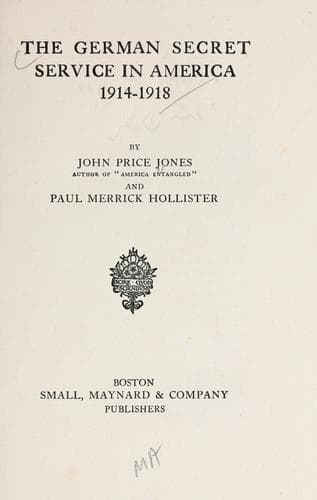
The German Secret Service in America 1914-1918Jones, John Price
History
The German Secret Service in America 1914-1918
Jones, John Price
World War, 1914-1918 -- Secret service -- Germany
"Your friend here has inquired in London, and he offers no matter what
price may be realizable in London at that time to take over the wool
from you at the original price, in which case you would naturally pay
all the expenses, which are estimated to be about 6 per cent. As you
see, it is not so simple to deal with your friends."
The German-American's offer meant a good profit to him, as the London
price of wool at that time had advanced nearly 15 per cent. Yet he
apparently fell into no ill favor with Berlin, for in June, 1916, the
German Foreign office wrote von Bernstorff:
"Interested parties here have repeatedly made representations for
preferential treatment of the firm of Forstmann & Huffman in Passaic,
N. J., in connection with shipment of coal tar dyes to the United
States of America. Since this pure German firm, as is well known
on your side, undertook last year the wool supply for Germany, and
therefore claim it has been especially badly treated by England, it
is most respectfully recommended to Your Excellency, should there
be no reason to the contrary, to arrange for the greatest possible
consideration for this firm in the later distribution of the shipments
to consumers which now are in prospect."
Necessity, the mother of invention, had forced America's production
of coal-tar derivatives and dyestuffs upward enormously during the
first year of war. As the British blockade tightened, the German
supply, which had long constituted the world supply, was cut off
completely. The value of dyestuffs in America increased enormously
from 1914 to 1915. Germany witnessed this growth with apprehension,
and realized gravely that export expansion would follow increased
and perfected production in America, which it promptly did. German
chemical interests involved in a drug house familiar with the German
market, have testified that their firm "paid three times the value"
of a cargo of dyestuffs shipped from Bremen to Baltimore in 1916 in
the huge undersea-boat _Deutschland_, "which paid for the ship and
cargo." Her sister ship, the _Bremen_, which set forth for America, but
never arrived, was also "built with money furnished by the dyestuff
manufacturers," according to Ambassador Gerard.
The _Deutschland_ herself was 300 feet long, with a cargo capacity of
some 800 tons. She docked at the North German Lloyd piers in Baltimore,
and after loading a cargo of rubber and nickel, took an opportune
moment one foggy twilight to cast off and slip out to sea. She not only
returned safely to Germany but made another round trip to America,
putting in the second time at New London. She was at sea about three
weeks on each crossing of the Atlantic.
Public-domain text, read in full here on John Shaqi.
Reviews
Reviews
No reviews yet
Be the first to share your thoughts on this work.
Elsewhere in the archive
Join the Discussion
Join the discussion
Sign in to leave a comment or review.
Sign InorCreate an account