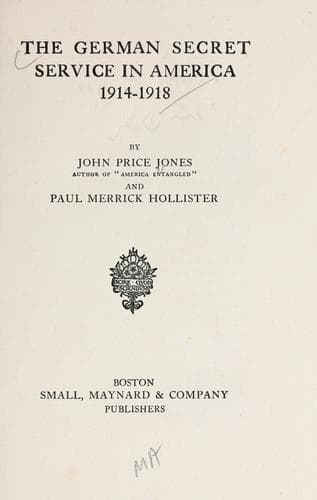
The German Secret Service in America 1914-1918Jones, John Price
History
The German Secret Service in America 1914-1918
Jones, John Price
World War, 1914-1918 -- Secret service -- Germany
The presence of several educators in the list may be accounted for
by the fact that the society existed apparently for the purpose of
supplying American college training to selected Hindu youths. Many of
them were sent to the United States at the expense of the Gaekwar of
Baroda, one of the richest and most influential of the Indian princes;
the Gaekwar's own son was a student in Harvard College in the years
1908-1912. Considerable sums of money were solicited from worthy folk
who believed that they were furthering the cause of enlightenment in
India; others who sincerely believed that British rule was tyrannical
gave frankly to the society to help an Indian nationalist movement for
home rule; others contributed freely for the promotion of any and every
anti-British propaganda in India. The source of the latter funds may be
suggested by the understanding which long existed between the Society
for the Advancement of India and the Clan-na-Gael, an understanding
witnessed by the frequent quotation in the disaffected press of India
of articles from the _Gaelic-American_. Another successful solicitor
was a contemptible Swami, Vivekahanda, who discussed soul matters to
New York's gullible-rich to his great profit until the police gathered
him in for a very earthly and material offense. But the students were
the best material for revolt, whether it was to be social or military,
and we shall see presently how they were made use of.
The Gaekwar of Baroda came to America in the first decade of the new
century and expressed freely at that time his dislike for the British.
At the time of the Muzaffarpur bomb outrage, in which the wife and
daughter of an English official were killed, the police found in the
outskirts of Calcutta a Hindu who had been educated at an American
college at the Gaekwar's expense and who was at that time conducting a
school of instruction in the use of explosives and small arms; he even
had considerable quantities of American arms and ammunition stored in
his house. The youths who held "Gaekwar scholarships" in America were
under the general oversight of a professor attached to the American
Museum of Natural History, and the accumulation of evidence of the
activities of the students finally caused his removal.
The Society established branches in Chicago, Denver, Seattle, and even
in St. John, New Brunswick, and it thrived on the Pacific Coast. Within
the purlieus of the University of California, there lived in 1913 one
Har Dyal, a graduate of St. John's college at Oxford. Har Dyal in that
year founded a publication called _Gadhr_, which being translated means
"mutiny," its main edition published in Urdu, other editions published
in other vernaculars, and appealing not only to Hindus, but to Sikhs
and Moslems. The publication and the chief exponents of its thought
formed the nucleus of a considerable system of anti-British activity.
Public-domain text, read in full here on John Shaqi.
Reviews
Reviews
No reviews yet
Be the first to share your thoughts on this work.
Elsewhere in the archive
Join the Discussion
Join the discussion
Sign in to leave a comment or review.
Sign InorCreate an account