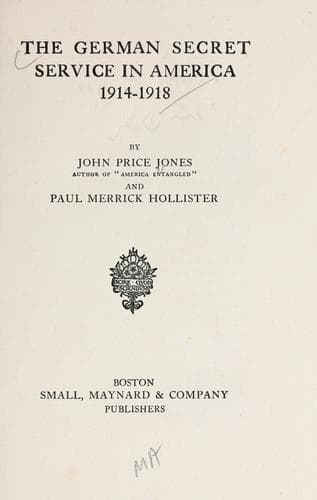
The German Secret Service in America 1914-1918Jones, John Price
History
The German Secret Service in America 1914-1918
Jones, John Price
World War, 1914-1918 -- Secret service -- Germany
This document was decoded from the official dictionary cipher and laid
in the hands of President Wilson almost immediately following the
rupture of diplomatic relations. It was made public on February 28,
when the public temper was at whitest heat. Mexico did not repudiate
the note at once, and four days later despatched a denial of having
received any such proposal as Zimmermann had suggested. Eckhart
was forcing Carranza's hand with the lure of the projected Central
American enterprise already outlined. (Eckhart had had Carranza so
completely under his influence at one time that when the United States
despatched to Mexico a friendly note warning her of the presence of
German submarines in the Gulf, Mexico retorted--at Eckhart's literal
dictation--that the United States might do well to ask the British
Navy why it did not prevent German undersea craft from approaching the
Americas.) The month of March fled by, and America went to war; since
that date no official expression except one of praise for Mexico's
attitude of amiable neutrality has issued from Washington.
Just as the proximity of Mexico to the United States had for a number
of years past carried with it the possibility, almost the certainty, of
differences between the two countries, rising out of the temperamental
differences of their peoples, so for a longer period had Ireland and
England suffered for their contiguity. It is a truism to remark that
the Irishman cherishes his national grievances, but that characteristic
accounts for a further phase of German intrigue on American soil.
Hatred of England sent many thousands of Irish to the United States in
the past fifty years. They found it a country to their liking, which
England was not, and although they had become indissolubly attached
to their adopted land, there were in America in 1914 (and there are
in 1918) numerous Irish who had no dearer wish than that England come
off second best in the great war. Allies after Germany's own heart
they were, therefore. They had been cultivated long since: in 1909,
when plans were being made for a centenary celebration in 1914 of
the peace that had reigned between the United States and England,
German-American and Irish-American interests began to raise a structure
of their own, exploiting the prominence which certain Germans, such
as Franz Sigel and Carl Schurz, had enjoyed in the construction of
the nation. The programme of these interests included the erection of
elaborate memorials over the graves of prominent German Americans,
the dissemination of legends of German heroes in America, and more
practically the frustrating of the projected Peace Centenary.
Public-domain text, read in full here on John Shaqi.
Reviews
Reviews
No reviews yet
Be the first to share your thoughts on this work.
Elsewhere in the archive
Join the Discussion
Join the discussion
Sign in to leave a comment or review.
Sign InorCreate an account