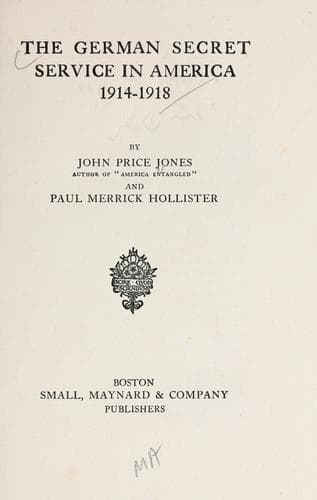
The German Secret Service in America 1914-1918Jones, John Price
History
The German Secret Service in America 1914-1918
Jones, John Price
World War, 1914-1918 -- Secret service -- Germany
Many of the organizations thus united for a practical purpose found a
clearing-house in the American Truth Society, of which Jeremiah O'Leary
was the head. Although the Centennial Celebration itself was rudely
interrupted by the advent of war, the German-Irish acquaintanceship
was nourished by the German propagandists in America. They observed
with pleasure the circulation by the Clan-na-Gael of cards informing
the Irish in America that troops from Erin were being assigned to the
most dangerous posts and the bloodiest attacks and subjected to the
most severe enemy fire in France, and that the hated British were
dragging Irish boys from their homes to fill up the ranks. Between
September, 1914, and April, 1915, funds amounting to $80,000 for the
purchase of arms and the printing of seditious papers and leaflets
were forwarded from America to Dublin banks, and then mysteriously
were withdrawn. An inflammatory publication known as _Bull_, published
by O'Leary, and not barred from the mails until September, 1917, went
broadcast over the United States, inciting bitterness against England,
and found a greedy circle of readers in the German-American population.
John Devoy, a Sinn Feiner of standing in America, fanned the flame
with a newspaper known as the _Gaelic American_, published in New
York, and it is this American-printed sheet which furnished the Irish
revolutionists with material for a part of the plot which they were
preparing for fruition in the year 1916.
[Illustration: _Copyright, International Film Service_
Jeremiah A. O'Leary]
In 1916 Sir Roger Casement, an Irish knight, made his way into Germany.
He was permitted to visit the prison camp at Limburg where some 3,000
Irish prisoners of war were quartered, and he moved about among them
attempting to obtain enlistments in an army which was to effect a
coup in Dublin to overthrow the British government in the Castle and
to proclaim an Irish Republic. He circulated numerous copies of the
_Gaelic American_ to arouse the men. He was variously received. Some
of the prisoners held their release worth treason--but only fifty-odd.
The greater majority rejected Sir Roger's offer, and some even chose
to curse and spit at the suggestion that they break their oaths of
allegiance to Great Britain. He succeeded, however, in enlisting German
financial assistance, and in early April, 1916, a cargo of captured
Russian arms and ammunition was forwarded to Kiel and loaded into the
German auxiliary steamship _Aud_.
Public-domain text, read in full here on John Shaqi.
Reviews
Reviews
No reviews yet
Be the first to share your thoughts on this work.
Elsewhere in the archive
Join the Discussion
Join the discussion
Sign in to leave a comment or review.
Sign InorCreate an account