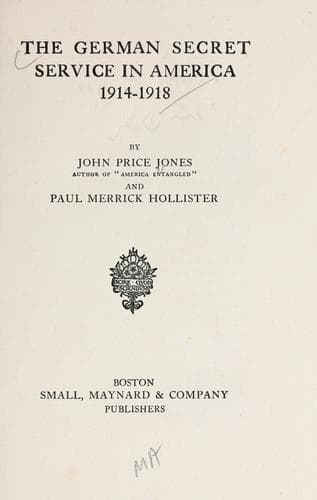
The German Secret Service in America 1914-1918Jones, John Price
History
The German Secret Service in America 1914-1918
Jones, John Price
World War, 1914-1918 -- Secret service -- Germany
Attorney-General Merton Lewis of New York State conducted an
investigation which revealed every step of Bolo's operations in New
York. His search of the records of the banks involved indicated that
a fund of some $50,000,000 in cash and negotiable securities lay on
deposit in America which the Deutsches Bank could place at the disposal
of von Bernstorff and his fellow conspirators at any time for any
purpose, and which was adequate as a reserve for any enterprise which
might present itself. The evidence against Bolo was forwarded to Paris,
and he was arrested. On October 4, 1917, Secretary Lansing made public
the correspondence which the State Department had intercepted.
The French public became hysterically interested in the case. Senator
Humbert promptly refunded the 5,500,000 francs which he had received
from Bolo for 1,600 shares in _Le Journal_. Almereyda of the _Bonnet
Rouge_ committed suicide in prison; his death dragged Malvy, Minister
of the Interior under Ribot, out of office under suspicion of trading
with the enemy; the editor of a Paris financial paper was imprisoned
on the same charge; "Boloism" became a generic term, and the French
government, feeling a growing restlessness on the part of the public,
encouraged the new diversion of spy-hunting which resulted in the
exposure of negotiations between Caillaux and German representatives in
Buenos Aires. Russia had been dissolved by similar German propaganda,
Italy, after vigorous advances into Italia Irridenta, had had her
military resistance sapped by another such campaign as Bolo proposed
for France, and had retreated to the Po valley; the sum total of
"Boloism" during the autumn and winter of 1917-1918 was an increased
conviction on the part of the Allied peoples that the line must be held
more firmly than ever, while the rear was combed for prominent traitors.
Thus, a year before she entered war, the United States supplied the
scene of one of the outstanding intrigues of the war. How voluble was
Adolph Pavenstedt in confessing his services as intermediary for the
Kaiser; Pavenstedt was interned in an American prison camp ... a rather
comfortable camp. Hugo Schmidt, who on his own testimony was the
accredited manipulator of enormous sums for the German government, was
ingenuous to a degree in his denial of any knowledge of what the money
paid Bolo was to be used for; Schmidt was interned. Bolo was shot.
Public-domain text, read in full here on John Shaqi.
Reviews
Reviews
No reviews yet
Be the first to share your thoughts on this work.
Elsewhere in the archive
Join the Discussion
Join the discussion
Sign in to leave a comment or review.
Sign InorCreate an account