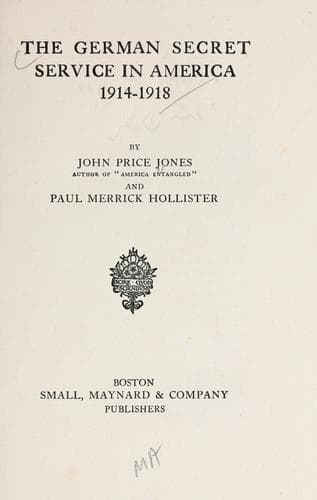
The German Secret Service in America 1914-1918Jones, John Price
History
The German Secret Service in America 1914-1918
Jones, John Price
World War, 1914-1918 -- Secret service -- Germany
The cases cited are picked at random out of a mass. They illustrate
the breathing periods given to Germans who had been active under
Bernstorff in disturbing America's peace and defying her laws. They
serve also to illustrate the contrast between the methods employed
by the United States, and those adopted by her Allies, from whom she
has taken other lessons in the business of warfare. France gave alien
enemies forty-eight hours in which to leave the soil of the country,
and any such person found at large after that date was to be interned
in a detention camp. To have interned all of the Germans in the United
States would have been impossible and the Government took some time to
find a second best method. By May 2 the Department of Justice was in a
position to announce that it had plans for internment camps for three
classes of aliens: prisoners of war, enemy aliens, and detained aliens,
and it announced on that date there were some 6,000 in those classes
already detained. By February 17, 1918, however, there were actually
no more than 1,870 aliens interned under the war department and under
military guard at Forts McPherson, Oglethorpe and Douglas, and some
2,000 at Hot Springs, North Carolina, in the Department of Labor's
detention camp.
At both camps the prisoners were fed and housed at the expense of the
Government, and it was not until the early spring of 1918 that they
were put to work.
From April 6 to July 10, 1917, an enemy alien could be employed by any
shipbuilder, tug-boat captain, lighterage firm or steamship line; he
could go about any waterfront at will, provided he did not enter the
so-called "barred zones" in the vicinity of Government military or
naval property, and he could make unmolested such observations as his
eyesight afforded of the shipping upon which the United States depends
for its share in this war. After that date he was forbidden such
employment, and denied approach to all wharves and ships. On July 9 the
Government discharged from its employ 200 German subjects who for weeks
past had been loading transports at the docks in an "Atlantic port." A
raid on the Hoboken waterfront in the following winter rounded up 200
more enemy aliens who had calmly ignored the "barred zone" regulations.
The Government was confronted with a stupendous problem. How to handle
with its normal peace-time police force the great unwieldy flow of
the alien population presented a constantly baffling question, yet it
was absolutely essential to the control of internal affairs that the
Government know the comings and goings of the enemies within its gates.
The date of February 13, 1918, was eventually set as the last on which
citizens of enemy countries living in the United States might set down
their finger prints and names and file their affidavits of residence
and condition.
Public-domain text, read in full here on John Shaqi.
Reviews
Reviews
No reviews yet
Be the first to share your thoughts on this work.
Elsewhere in the archive
Join the Discussion
Join the discussion
Sign in to leave a comment or review.
Sign InorCreate an account