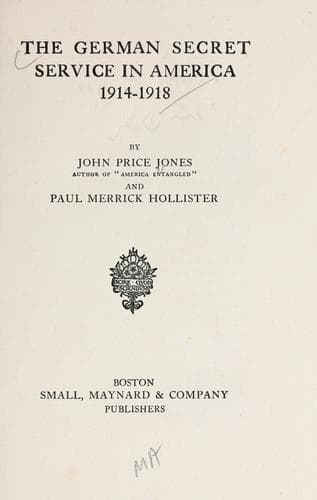
The German Secret Service in America 1914-1918Jones, John Price
History
The German Secret Service in America 1914-1918
Jones, John Price
World War, 1914-1918 -- Secret service -- Germany
What facilities had the United States provided for transacting this
great volume of additional protective duty? There existed, first of
all, the Department of Justice, whose chief function in peace-time
had been the enforcement through its investigators and prosecutors
of acts of Congress, such as the so-called Mann "White Slave" Act,
and the Sherman "Anti-Trust" Act. There was the United States Secret
Service, a bureau of the Treasury Department, whose chief function had
been the detection of smuggling and counterfeiting and the protection
of the person of the President. There was the Intelligence Bureau
of the War Department, and a similar Bureau of the Navy Department,
both undermanned, as was every other branch of our military forces
at that time. The advent of war brought a complicated necessity for
coordination of these four branches and of several other Federal
investigating bureaus.
The German did not wait for coordination. He inspired food riots among
the poorer classes of the lower East Side in New York. He opposed the
draft law, rallying to his support the Socialist, the Anarchist, and
the Industrial Worker of the World, under whose cloak he hid, not too
well concealed. He celebrated the declaration of war by blowing up a
munitions plant at Eddystone, Pa., on April 10, 1917, and killing 112
persons, most of whom were women and girls. He sneaked information into
Germany through the Swedish legation. He tried to promote strikes in
Pittsburg, but his agent, Walter Zacharias, was arrested. He tried
to dynamite the Elephant-Butte dam on the Rio Grande, but his agent,
Dr. Louis Kopf, was caught. He caused a serious revolution in Cuba
until his agents were expelled. He tried to block the Liberty Loans,
in vain. He tried to obstruct the collection of Red Cross funds. He
caused strikes in the airplane-spruce forests of the Northwest. He
assisted Lieutenant Hans Berg of the captured German prize _Appam_ to
escape from Fort McPherson with nine of his crew in October, 1917. He
erected secret wireless stations at various points, to communicate to
Berlin via Mexico, whither thousands of his army reservists had fled
on false passports at the outbreak of war. He smuggled information
of military importance in and out of the country in secret inks, on
neutral vessels, and even wrote them (on one occasion) in cipher
upon the shoulder of a prima donna. He burned warehouses and shell
plants. He sawed the keel of a transport nearly through. He placed a
culture of ptomaine germs in the milk supply of the cadets' school
at Fort Leavenworth. He invented a chemical preparation which would
cause painful injury to the kidneys of every man who drank water in a
certain army cantonment. He received Irish rebellionists and negotiated
with them for further revolution. He made his way into our munitions
plants and secured data which he forwarded to Berlin; he worked in our
aeroplane plants and deliberately weakened certain vital parts of the
Public-domain text, read in full here on John Shaqi.
Reviews
Reviews
No reviews yet
Be the first to share your thoughts on this work.
Elsewhere in the archive
Join the Discussion
Join the discussion
Sign in to leave a comment or review.
Sign InorCreate an account