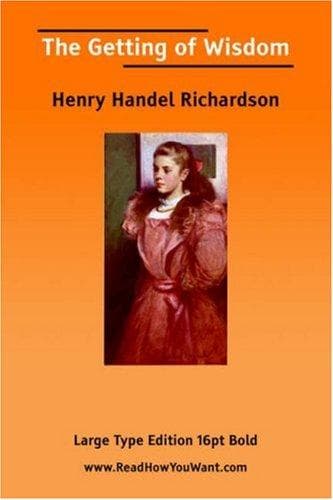
Australia -- Fiction; Autobiographical fiction; Bildungsromans; Melbourne (Vic.) -- Fiction; Young women -- Fiction
For months, she browsed unchecked. As her choice had to be made with
extreme celerity, and from those shelves nearest the piano, it was in
the nature of things that it was not invariably a happy one. For some
time she had but moderate luck, and sampled queer foods. To these must
be reckoned a translation of FAUST, which she read through, to the end
of the First Part at least, with a kind of dreary wonder why such a
dull thing should be called great. For her next repast, she sought hard
and it was in the course of this rummage that she had the strangest
find of all. Running a skilled eye over the length of a shelf close at
hand, she hit on a slim, blue volume, the title of which at once
arrested her attention. For, notwithstanding her fourteen years, and
her dabblings in Richardson and Scott, Laura's liking for a real
child's book was as strong as it had ever been; and A DOLL'S HOUSE
seemed to promise good things. Deftly extracting the volume, she struck
up her scales and began to read.
This was the day on which, after breakfast, Mrs. Gurley pulverised her
with the remark: "A new, and, I must say, extremely interesting,
fashion of playing scales, Laura Rambotham! To hold, the forte pedal
down, from beginning to end!"
Laura was unconscious of having sinned in this way. But it might quite
well be so. For she had spent a topsy-turvy, though highly engrossing
hour. In place of the children's story she anticipated, she had found
herself, on opening the book, confronted by the queerest stuff she had
ever seen in print. From the opening sentence on. To begin with, it was
a play--and Laura had never had a modern prose play in her hand
before--and then it was all about the oddest, yet the most commonplace
people. It seemed to her amazingly unreal--how these people spoke and
behaved--she had never known anyone like them; and yet again so true,
in the way it dragged in everyday happenings, so petty in its rendering
of petty things, that it bewildered and repelled her: why, some one
might just as well write a book about Mother or Sarah! Her young,
romantic soul rose in arms against this, its first bluff contact with
realism, against such a dispiriting sobriety of outlook. Something
within her wanted to cry out in protest as she read--for read she did,
on three successive days, with an interest she could not explain. And
that was not all. It was worse that the people in this book--the
extraordinary person who was married, and had children, and yet ate
biscuits out of a bag and said she didn't; the man who called her his
lark and his squirrel--as if any man ever did call his wife such
names!--all these people seemed eternally to be meaning something
different from what they said; something that was for ever eluding her.
It was most irritating.-- There was, moreover, no mention of a doll's
house in the whole three acts.
Public-domain text, read in full here on John Shaqi.
Reviews
Reviews
No reviews yet
Be the first to share your thoughts on this work.
Elsewhere in the archive
Join the Discussion
Join the discussion
Sign in to leave a comment or review.
Sign InorCreate an account