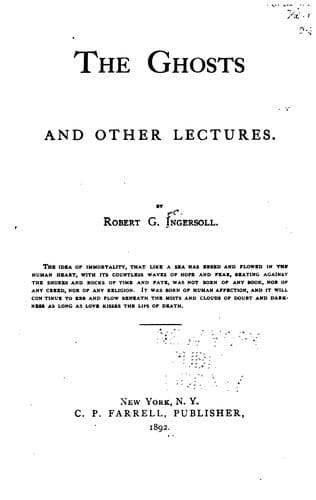
The Ghosts, and Other LecturesIngersoll, Robert Green
Religion
The Ghosts, and Other Lectures
Ingersoll, Robert Green
Free thought
In some instances, bargains and compromises were made with the ghosts.
One case is given where a multitude of devils traded a man for a herd
of swine. In this transaction the devils were the losers, as the swine
immediately drowned themselves in the sea. This idea of disease appears
to have been almost universal, and is by no means yet extinct.
The contortions of the epileptic, the strange twitchings of those
afflicted with chorea, the shakings of palsy, dreams, trances, and the
numberless frightful phenomena produced by diseases of the nerves, were
all seized upon as so many proofs that the bodies of men were filled
with unclean and malignant ghosts.
Whoever endeavored to account for these things by natural causes,
whoever attempted to cure diseases by natural means, was denounced by
the church as an infidel. To explain anything was a crime. It was to the
interest of the priest that all phenomena should be accounted for by the
will and power of gods and devils. The moment it is admitted that all
phenomena are within the domain of the natural, the necessity for a
priest has disappeared. Religion breathes the air of the supernatural.
Take from the mind of man the idea of the supernatural, and religion
ceases to exist. For this reason, the church has always despised the
man who explained the wonderful. Upon this principle, nothing was
left undone to stay the science of medicine. As long as plagues and
pestilences could be stopped by prayer, the priest was useful. The
moment the physician found a cure, the priest became an extravagance.
The moment it began to be apparent that prayer could do nothing for the
body, the priest shifted his ground and began praying for the soul.
Long after the devil idea was substantially abandoned in the practice
of medicine, and when it was admitted that God had nothing to do with
ordinary coughs and colds, it was still believed that all the frightful
diseases were sent by him as punishments for the wickedness of the
people. It was thought to be a kind of blasphemy to even try, by any
natural means, to stay the ravages of pestilence. Formerly, during the
prevalence of plague and epidemics, the arrogance of the priest was
boundless. He told the people that they had slighted the clergy, that
they had refused to pay tithes, that they had doubted some of the
doctrines of the church, and that God was now taking his revenge. The
people for the most part, believed this infamous tissue of priestcraft.
They hastened to fall upon their knees; they poured out their wealth
upon the altars of hypocrisy; they abased and debased themselves; from
their minds they banished all doubts, and made haste to crawl in the
very dust of humility.
Public-domain text, read in full here on John Shaqi.
Reviews
Reviews
No reviews yet
Be the first to share your thoughts on this work.
Join the Discussion
Join the discussion
Sign in to leave a comment or review.
Sign InorCreate an account