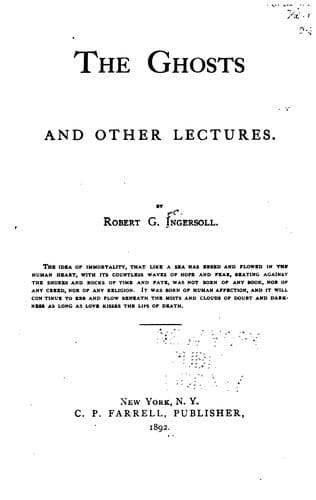
The Ghosts, and Other LecturesIngersoll, Robert Green
Religion
The Ghosts, and Other Lectures
Ingersoll, Robert Green
Free thought
Nothing can exceed the mendacity of the religious press. I have had some
little experience with political editors, and am forced to say, that
until I read the religious papers, I did not know what malicious and
slimy falsehoods could be constructed from ordinary words. The ingenuity
with which the real and apparent meaning can be tortured out of
language, is simply amazing. The average religious editor is intolerant
and insolent; he knows nothing of affairs; he has the envy of failure,
the malice of impotence, and always accounts for the brave and generous
actions of unbelievers, by low, base and unworthy motives.
By this time, even the clergy should know that the intellect of the
Nineteenth Century needs no, guardian. They should cease to regard
themselves as shepherds defending flocks of weak, silly and fearful
sheep from the claws and teeth of ravening wolves. By this time they
should know that the religion of the ignorant and brutal Past no
longer satisfies the heart and brain; that the miracles have become
contemptible; that the "evidences" have ceased to convince; that the
spirit of investigation cannot be stopped nor stayed; that the Church
is losing her power; that the young are holding in a kind of tender
contempt the sacred follies of the old; that the pulpit and pews no
longer represent the culture and morality of the world, and that the
brand of intellectual inferiority is upon the orthodox brain.
Men should be liberated from the aristocracy of the air. Every chain
of superstition should be broken. The rights of men and women should
be equal and sacred--marriage should be a perfect partnership--children
should be governed by kindness,--every family should be a
republic--every fireside a democracy.
It seems almost impossible for religious people to really grasp the idea
of intellectual freedom. They seem to think that man is responsible for
his honest thoughts; that unbelief is a crime; that investigation is
sinful; that credulity is a virtue, and that reason is a dangerous
guide. They cannot divest themselves of the idea that in the realm of
thought there must be government--authority and obedience--laws and
penalties--rewards and punishments, and that somewhere in the universe
there is a penitentiary for the soul.
Public-domain text, read in full here on John Shaqi.
Reviews
Reviews
No reviews yet
Be the first to share your thoughts on this work.
Join the Discussion
Join the discussion
Sign in to leave a comment or review.
Sign InorCreate an account