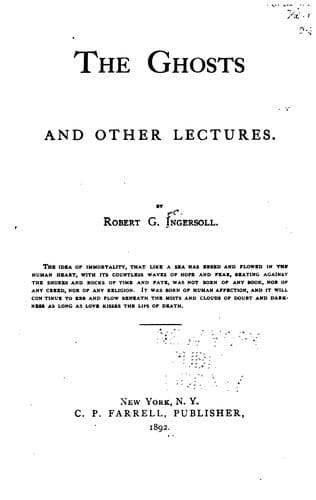
The Ghosts, and Other LecturesIngersoll, Robert Green
Religion
The Ghosts, and Other Lectures
Ingersoll, Robert Green
Free thought
The believers in ghosts claim still, that they are the only wise and
virtuous people upon the earth; claim still, that there is a difference
between them and unbelievers so vast, that they will be infinitely
rewarded, and the others infinitely punished.
I ask you to-night, do the theories and doctrines of the theologians
satisfy the heart or brain of the Nineteenth Century?
Have the churches the confidence of mankind?
Does the merchant give credit to a man because he belongs to a church?
Does the banker loan money to a man because he is a Methodist or
Baptist?
Will a certificate of good standing in any church be taken as collateral
security for one dollar?
Will you take the word of a church member, or his note, or his oath,
simply because he is a church member?
Are the clergy, as a class, better, kinder and more generous to their
families--to their fellow-men--than doctors, lawyers, merchants and
farmers?
Does a belief in ghosts and unreasonable things necessarily make people
honest?
When a man loses confidence in Moses, must the people lose confidence in
him?
Does not the credit system in morals breed extravagance in sin?
Why send missionaries to other lands while every penitentiary in ours is
filled with criminals?--
Is it philosophical to say that they who do right carry a cross?
Is it a source of joy to think that perdition is the destination of
nearly all of the children of men?
Is it worth while to quarrel about original sin--when there is so much
copy?
Does it pay to dispute about baptism, and the trinity, and
predestination, and apostolic succession and the infallibility of
churches, of popes and of books? Does all this do any good?
Are the theologians welcomers of new truths? Are they noted for their
candor? Do they treat an opponent with common fairness? Are they
investigators? Do they pull forward, or do they hold back?
Is science indebted to the church for a solitary fact?
What church is an asylum for a persecuted truth?
What great reform has been inaugurated by the church?
Did the church abolish slavery?
Has the church raised its voice against war?
I used to think that there was in religion no real restraining force.
Upon this point my mind has changed. Religion will prevent man from
committing artificial crimes and offenses.
A man committed murder. The evidence was so conclusive that he confessed
his guilt.
He was asked why he killed his fellow-man.
He replied: "For money."
"Did you get any?"
"Yes."
"How much?"
"Fifteen cents."
"What did you do with this money?" "Spent it!" "What for?" "Liquor."
"What else did you find upon the dead man?" "He had his dinner in a
bucket--some meat and bread."
"What did you do with that?"
"I ate the bread."
"What did you do with the meat?"
"I threw it away."
"Why?"
"It was Friday."
Public-domain text, read in full here on John Shaqi.
Reviews
Reviews
No reviews yet
Be the first to share your thoughts on this work.
Join the Discussion
Join the discussion
Sign in to leave a comment or review.
Sign InorCreate an account