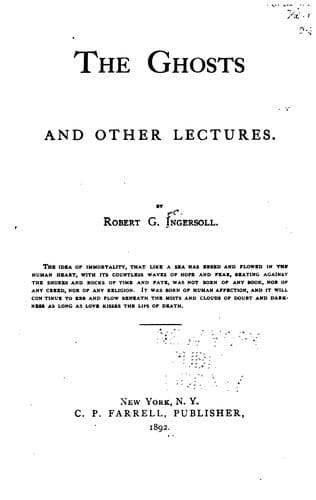
The Ghosts, and Other LecturesIngersoll, Robert Green
Religion
The Ghosts, and Other Lectures
Ingersoll, Robert Green
Free thought
Standing in the presence of the Unknown, all have the same right to
think, and all are equally interested in the great questions of origin
and destiny. All I claim, all I plead for, is liberty thought and
expression. That is all. I do not pretend to tell what is absolutely
true, but what I think is true. I do not pretend to tell all the truth.
I do not claim that I have floated level with the heights of thought, or
that I have descended to the very depths of things. I simply claim that
what ideas I have, I have a right to express; and that any man who
denies that right to me is an intellectual thief and robber. That is
all.
Take those chains from the human soul. Break those fetters. If I have no
right to think, why have I a brain? If I have no such right, have three
or four men, or any number, who may get together, and sign a creed, and
build a house, and put a steeple upon it, and a bell in it--have they
the right to think? The good men, the good women are tired of the whip
and lash in the realm of thought. They remember the chain and fagot
with a shudder. They are free, and they give liberty to others. Whoever
claims any right that he is unwilling to accord to his fellow-men is
dishonest and infamous.
In the good old times, our fathers had the idea that they could make
people believe to suit them. Our ancestors, in the ages that are gone,
really believed that by force you could convince a man. You cannot
change the conclusion of the brain by torture; nor by social ostracism.
But I will tell you what you can do by these, and what you have done.
You can make hypocrites by the million. You can make a man say that
he has changed his mind; but he remains of the same opinion still. Put
fetters all over him; crush his feet in iron boots; stretch him to the
last gasp upon the holy rack; burn him, if you please, but his ashes
will be of the same opinion still.
Our fathers in the good old times--and the best thing I can say about
them is, that they have passed away--had an idea that they could force
men to think their way. That idea is still prevalent in many parts, even
of this country. Even in our day some extremely religious people say,
"We will not trade with that man; we will not vote for him; we will not
hire him if he is a lawyer; we will die before we will take his medicine
if he is a doctor; we will not invite him to dinner; we will socially
ostracise him; he must come to our church; he must believe our
doctrines; he must worship our god or we will not in any way contribute
to his support."
Public-domain text, read in full here on John Shaqi.
Reviews
Reviews
No reviews yet
Be the first to share your thoughts on this work.
Join the Discussion
Join the discussion
Sign in to leave a comment or review.
Sign InorCreate an account