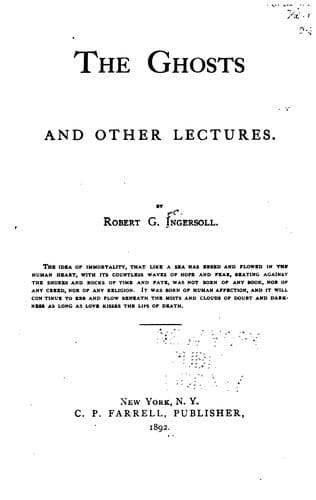
The Ghosts, and Other LecturesIngersoll, Robert Green
Religion
The Ghosts, and Other Lectures
Ingersoll, Robert Green
Free thought
As far as I am concerned I wish to be out on the high seas. I wish to
take my chances with wind, and wave, and star. And I had rather go down
in the glory and grandeur of the storm, than to rot in any orthodox
harbor whatever.
After all, we are improving from age to age. The most orthodox people in
this country two hundred years ago would have been burned for the crime
of heresy. The ministers who denounce me for expressing my thought would
have been in the Inquisition themselves. Where once burned and blazed
the bivouac fires of the army of progress, now glow the altars of the
church. The religionists of our time are occupying about the same ground
occupied by heretics and infidels of one hundred years ago. The church
has advanced in spite, as it were, of itself. It has followed the army
of progress protesting and denouncing, and had to keep within protesting
and denouncing distance. If the church had not made great progress I
could not express my thoughts.
Man, however, has advanced just exactly in the proportion with which he
has mingled his thought with his labor. The sailor, without control
of the wind and wave, knowing nothing or very little of the mysterious
currents and pulses of the sea, is superstitious. So also is the
agriculturist, whose prosperity depends upon something he cannot
control. But the mechanic, when a wheel refuses to turn, never thinks of
dropping on his knees and asking the assistance of some divine power.
He knows there is a reason. He knows that something is too large or too
small; that there is something wrong with his machine; and he goes to
work and he makes it larger or smaller, here or there, until the wheel
will turn. Now, just in proportion as man gets away from being, as it
were, the slave of his surroundings, the serf of the elements,--of the
heat, the frost, the snow, and the lightning,--just to the extent that
he has gotten control of his own destiny, just to the extent that he has
triumphed over the obstacles of nature, he has advanced physically and
intellectually. As man develops, he places a greater value upon his own
rights. Liberty becomes a grander and diviner thing. As he values his
own rights, he begins to value the rights of others. And when all men
give to all others all the rights they claim for themselves, this world
will be civilized.
Public-domain text, read in full here on John Shaqi.
Reviews
Reviews
No reviews yet
Be the first to share your thoughts on this work.
Join the Discussion
Join the discussion
Sign in to leave a comment or review.
Sign InorCreate an account