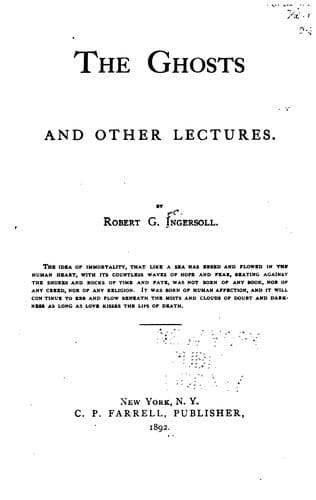
The Ghosts, and Other LecturesIngersoll, Robert Green
Religion
The Ghosts, and Other Lectures
Ingersoll, Robert Green
Free thought
And what more? That the people are the source of political power. That
was not only a revelation, but it was a revolution. It changed the ideas
of people with regard to the source of political power. For the first
time it made human beings men. What was the old idea? The old idea was
that no political power came from, nor in any manner belonged to, the
people. The old idea was that the political power came from the clouds;
that the political power came in some miraculous way from heaven; that
it came down to kings, and queens, and robbers. That was the old idea.
The nobles lived upon the labor of the people; the people had no rights;
the nobles stole what they had and divided with the kings, and the kings
pretended to divide what they stole with God Almighty. The source, then,
of political power was from above. The people were responsible to the
nobles, the nobles to the king, and the people had no political rights
whatever, no more than the wild beasts of the forest. The kings were
responsible to God; not to the people. The kings were responsible to the
clouds; not to the toiling millions they robbed and plundered.
And our forefathers, in this declaration of independence, reversed this
thing, and said: No; the people, they are the source of political power,
and their rulers, these presidents, these kings, are but the agents and
servants of the great, sublime people. For the first time, really, in
the history of the world, the king was made to get off the throne
and the people were royally seated thereon. The people became the
sovereigns, and the old sovereigns became the servants and the agents
of the people. It is hard for you and me now to imagine even the immense
results of that change. It is hard for you and for me, at this day, to
understand how thoroughly it had been ingrained in the brain of almost
every man, that the king had some wonderful right over him; that in
some strange way the king owned him; that in some miraculous manner he
belonged, body and soul, to somebody who rode on a horse--to somebody
with epaulettes on his shoulders and a tinsel crown upon his brainless
head.
Our forefathers had been educated in that idea, and when they first
landed on American shores they believed it. They thought they belonged
to somebody, and that they must be loyal to some thief, who could trace
his pedigree back to antiquity's most successful robber.
Public-domain text, read in full here on John Shaqi.
Reviews
Reviews
No reviews yet
Be the first to share your thoughts on this work.
Join the Discussion
Join the discussion
Sign in to leave a comment or review.
Sign InorCreate an account