The Girl at the Halfway House: A Story of the PlainsHough, Emerson
General
The Girl at the Halfway House: A Story of the Plains
Hough, Emerson
Great Plains -- Fiction; Historical fiction, American
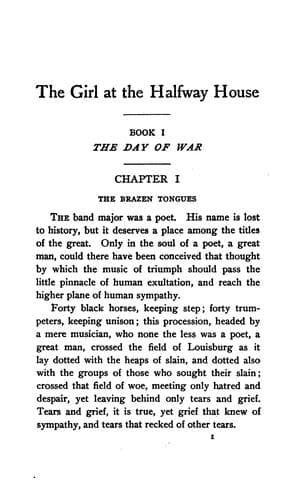
Near the intrenchment where the bitter close had been, and where there
was need alike for note of triumph, and forgetfulness, the band major
marshalled his music, four deep and forty strong, and swung out into
the anthem of the flag. The march was now generally and steadily
begun. The head of the column broke from the last cover of the wood
and came into full sight at the edge of the open country. Thus there
came into view the whole panorama of the field, dotted with the slain
and with those who sought the slain. The music of triumph was
encountered by the concerted voice of grief and woe. There appeared
for the feet of this army not a mere road, a mere battlefield, but a
ground sacred, hedged high about, not rudely to be violated.
But the band major was a poet, a great man. There came to him no order
telling him what he should do, but the thing was in his soul that
should be done. There came to him, wafted from the field of sorrow, a
note which was command, a voice which sounded to him above the voices
of his own brasses, above the tapping of the kettledrums. A gesture of
command, and the music ceased absolutely. A moment, and it had resumed.
The forty black horses which made up this regimental band were the
pride of the division. Four deep, forty strong, with arching necks,
with fore feet reaching far and drooping softly, each horse of the
famous cavalry band passed on out upon the field of Louisburg with such
carriage as showed it sensible of its mission. The reins lay loose
upon their necks, but they kept step to the music which they felt.
Forty horses paced slowly forward, keeping step. Forty trumpeters,
each man with his right hand aloft, holding his instrument, his left
hand at his side, bearing the cap which he had removed, rode on across
the field of Louisburg. The music was no longer the hymn of triumph.
Softly and sadly, sweetly and soothingly, the trumpets sang a melody of
other days, an air long loved in the old-time South. And Annie Laurie,
weeping, heard and listened, and wept the more, and blessed God for her
tears!
BOOK II
THE DAY OF THE BUFFALO
CHAPTER IV
BATTERSLEIGH OF THE RILE IRISH
Public-domain text, read in full here on John Shaqi.
Reviews
Reviews
No reviews yet
Be the first to share your thoughts on this work.
Join the Discussion
Join the discussion
Sign in to leave a comment or review.
Sign InorCreate an account