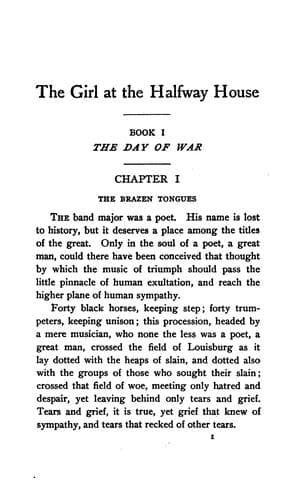
The Girl at the Halfway House: A Story of the PlainsHough, Emerson
General
The Girl at the Halfway House: A Story of the Plains
Hough, Emerson
Great Plains -- Fiction; Historical fiction, American
The sheriff of Ellisville looked thoughtful as he tested the machinery
of the law. He had a warrant for a new bad man who had come up from
the Indian nations, and who had celebrated his first day in town by
shooting two men who declined to get off the sidewalk, so that he could
ride his horse more comfortably there. The sheriff left the warrant on
the table, as was his custom, this paper being usually submitted with
the corpse at the inquest. The sheriff hummed a tune as he cleaned his
revolver. He was the law.
Bill Watson, the sheriff of Ellisville, was a heavily built man,
sandy-haired, red-mustached, and solid. His legs were bowed and his
carriage awkward. He had thick, clumsy-looking fingers, whose
appearance belied their deftness. Bill Watson had gone through the
Quantrell raid in his time. It was nothing to him when he was to be
killed. Such a man is careful in his shooting, because he is careless
of being shot, having therefore a vast advantage over the desperado of
two or three victims, who does not yet accept the fact that his own
days are numbered. The only trouble in regard to this new bad man from
below was that his mental attitude on this point was much the same as
that of Sheriff Bill Watson. Therefore the sheriff was extremely
careful about the oiling of the cylinder.
The great cattle drive was at its height. Buyers from the territorial
ranges of the North and Northwest, now just beginning to open up, bid
in market against the men from the markets of the East. Prices
advanced rapidly. Men carried thousands of dollars in the pockets of
their greasy "chaps." Silver was no longer counted. There were
hardware stores which sold guns and harness-shops which sold saddles.
There were twoscore saloons which held overflow meetings, accommodating
those whom the Cottage bar would not hold. There were three
barber-shops, to which went only the very weary. The corral of the
Cottage, where the drovers stopped, was large enough to hold two
hundred horses, with comfortable space for roping, and the snubbing
post was grooved with the wear of many ropes. The central street
needed no paving, for it was worn hard as flint. Long rows of cattle
chutes lined the railroad yards, whence came continuous din of
bellowing, crowding, maddened cattle, handled with ease and a certain
exultation by men who had studied nothing but this thing. Horsemen
clattered up and down the street day and night--riding, whether drunk
or sober, with the incomparable confidence of the greatest horse
country the world has ever known. Everywhere was the bustle of a
unique commerce, mingled with a colossal joy of life. The smokes from
the dugouts and shacks now began to grow still more numerous in the
region round about, but there were not many homes, because there were
not many women. For this reason men always kill each other very much
more gladly and regularly than they do in countries where there are
Public-domain text, read in full here on John Shaqi.
Reviews
Reviews
No reviews yet
Be the first to share your thoughts on this work.
Elsewhere in the archive
Join the Discussion
Join the discussion
Sign in to leave a comment or review.
Sign InorCreate an account