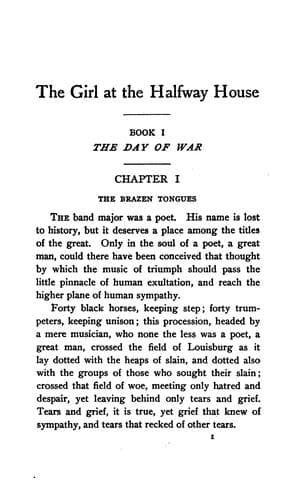
The Girl at the Halfway House: A Story of the PlainsHough, Emerson
General
The Girl at the Halfway House: A Story of the Plains
Hough, Emerson
Great Plains -- Fiction; Historical fiction, American
In the North the story was the same. The young men, taken from the
fields and marts to the camps and marches of the war, could not easily
return to the staid ways of their earlier life. From New England to
Michigan, from Michigan to Minnesota, many Northern families began to
move also toward that West which offered at least opportunity for
change. Thus there poured into the West from many different
directions, but chiefly from two right-angling directions which
intersected on the Plains, a diverse population whose integers were
later with phenomenal swiftness to merge and blend. As in the war the
boldest fought, so in emigration the boldest travelled, and the West
had the pick of the land. In Illinois and Iowa, after the war had
ended, you might have seen a man in flapping blue army overcoat hewing
timber for fences on the forgotten farms, or guiding the plough across
the black reeking sod; but presently you must have also seen the
streams of white-topped wagons, sequel to the white tented fields,
moving on, pushing toward the West, the land of action and adventure,
the land of hope and promise.
As all America was under canvas, it was not strange that Colonel
Battersleigh should find his home in a tent, and that this tent should
be pitched upon the Western Plains. Not that he had gone directly to
the West after the mustering out of his regiment. To the contrary, his
first abode had been in the city of New York, where during his brief
stay he acquired a certain acquaintance. Colonel Battersleigh was
always a striking figure, the more so by reason of his costume, which
was invariably the same. His broad cavalry hat, his shapely varnished
boots, his gauntlets, his sweeping cloak, made him fairly historic
about the clubs. His air, lofty, assured, yet ever suave, showed that
he classified himself cheerfully as being of the natural aristocracy of
the earth. When Colonel Battersleigh had occasion to sign his name it
was worth a dinner to see the process, so seriously did he himself
regard it. "Battersleigh"--so stood the name alone, unsupported and
self-sufficient. Seeing which inscription in heavy black lines, many a
man wondered, considering that he had discovered an Old-World custom,
and joining in the belief of the owner of the name that all the world
must know the identity of Battersleigh.
What were the financial resources of Battersleigh after the cessation
of his pay as a cavalry officer not even his best friends could
accurately have told. It was rumoured that he was the commissioner in
America of the London Times. He was credited with being a Fellow of
the Royal Geographical Society. That he had a history no one could
doubt who saw him come down the street with his broad hat, his sweeping
cloak, his gauntlets, his neatly varnished boots.
Public-domain text, read in full here on John Shaqi.
Reviews
Reviews
No reviews yet
Be the first to share your thoughts on this work.
Join the Discussion
Join the discussion
Sign in to leave a comment or review.
Sign InorCreate an account