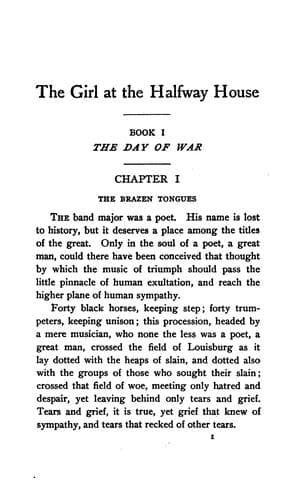
The Girl at the Halfway House: A Story of the PlainsHough, Emerson
General
The Girl at the Halfway House: A Story of the Plains
Hough, Emerson
Great Plains -- Fiction; Historical fiction, American
To Franklin the days and months and years went by unpunctuated, his
life settling gradually into the routine of an unhappy calm. He
neglected too much the social side of life, and rather held to his old
friends than busied himself with the search for new. Battersleigh was
gone, swiftly and mysteriously gone, though with the promise to return
and with the reiteration of his advice and his well wishes. Curly was
gone--gone up the Trail into a far and mysterious country, though he,
too, promised to remember Ellisville, and had given hostage for his
promise. His friends of the Halfway House were gone, for though he
heard of them and knew them to be prosperous, he felt himself, by
reason of Mary Ellen's decision, in propriety practically withdrawn
from their personal acquaintance. Of the kaleidoscope of the oncoming
civilization his eye caught but little. There had again fallen upon
his life a season of blight, or self-distrust, of dull dissatisfaction
with the world and with living. As in earlier years he had felt unrest
and known the lack of settled purpose, so now, after having seen all
things apparently set in order before him for progressive
accomplishment, he had fallen back once more into that state of
disbelief, of that hopeless and desperate awakening properly reserved
only for old age, when the individual realizes that what he does is of
itself of no consequence, and that what he is or is not stops no single
star an atom in its flight, no blade of grass an iota in its growing.
Paralysis of the energies too often follows upon such self-revelations;
and indeed it seemed to Franklin that he had suffered some deep and
deadly benumbing of his faculties. He could not welcome the new days.
His memory was set rather on the old days, so recent and in some way so
dear. He loved the forgotten thunder of the buffalo, but in his heart
there rose no exultation at the rumble of the wheels. Still
conscientious, he plodded, nor did he cease to aspire even in his own
restricted avocations. Because of his level common sense, which is the
main ingredient in the success-portion, he went easily into the first
councils of the community. Joylessly painstaking and exact, he still
prospered in what simple practice of the law there offered, acting as
counsel for the railway, defending a rare criminal case, collecting
accounts, carrying on title contests and "adverse" suits in the many
cases before the Register of the Land Office, and performing all the
simple humdrum of the busy country lawyer. He made more and more
money, since at that time one of his position and opportunities could
hardly avoid doing so. His place in the business world was assured.
He had no occasion for concern.
Public-domain text, read in full here on John Shaqi.
Reviews
Reviews
No reviews yet
Be the first to share your thoughts on this work.
Elsewhere in the archive
Join the Discussion
Join the discussion
Sign in to leave a comment or review.
Sign InorCreate an account