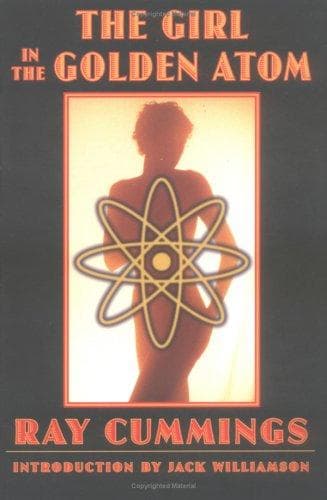
Atoms -- Fiction; Chemists -- Fiction; Love stories; Science fiction
"All the land is divided up _pro rata_ and given by each city to its
citizens. At the death of its owner it reverts to the government, and
each citizen coming of age receives his share from the surplus always
remaining."
"What about women? Can they own land too?" asked the Very Young Man.
"They have identical rights with men in everything," the Chemist
answered.
"But women surely cannot cultivate their own land?" the Doctor said.
Evidently he was thinking of Lylda's fragile little body, and certainly
if most of the Oroid women were like her, labour in the fields would be
for them quite impossible.
"A few women, by choice, do some of the lighter forms of manual
labor--but they are very few. Nearly every woman marries within a few
years after she receives her land; if it is to be cultivated, her
husband then takes charge of it."
"Is the cultivation of land compulsory?" asked the Big Business Man.
"Only when in a city's district a shortage of food is threatened. Then
the government decides the amount and kind of food needed, and the
citizens, drawn by lot, are ordered to produce it. The government
watches very carefully its food supply. In the case of overproduction,
certain citizens, those less skillful, are ordered to work at something
else.
"This supervision over supply and demand is exercised by the government
not only in the question of food but in manufactures, in fact, in all
industrial activities. A very nice balance is obtained, so that
practically no unnecessary work is done throughout the nation.
"And gentlemen, do you know, as a matter of fact, I think that is the
secret of a race of people being able to live without having to work
most of its waking hours? If your civilization could eliminate all its
unnecessary work, there would be far less work to do."
"I wonder--isn't this balance of supply and demand very difficult to
maintain?" asked the Big Business Man thoughtfully.
"Not nearly so difficult as you would think," the Chemist answered. "In
the case of land cultivation, the government has a large reserve, the
cultivation of which it adjusts to maintain this balance. Thus, in some
districts, the citizens do as they please and are never interfered with.
"The same is true of manufactures. There is no organized business in the
nation--not even so much as the smallest factory--except that conducted
by the government. Each city has its own factories, whose production is
carefully planned exactly to equal the demand."
"Suppose a woman marries and her land is far away from her husband's?
That would be sort of awkward, wouldn't it?" suggested the Very Young
Man.
"Each year at a stated time," the Chemist answered, "transfers of land
are made. There are generally enough people who want to move to make
satisfactory changes of location practical. And then of course, the
government always stands ready to take up any two widely separate pieces
of land, and give others in exchange out of its reserve."
Public-domain text, read in full here on John Shaqi.
Reviews
Reviews
No reviews yet
Be the first to share your thoughts on this work.
Elsewhere in the archive
Join the Discussion
Join the discussion
Sign in to leave a comment or review.
Sign InorCreate an account