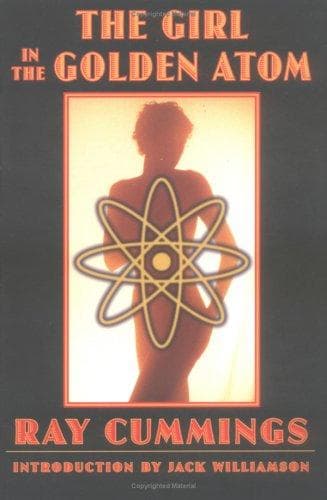
Atoms -- Fiction; Chemists -- Fiction; Love stories; Science fiction
"Suppose you don't like the new land as well?" objected the Very Young
Man.
"Almost all land is of equal value," answered the Chemist. "And of
course, its state of cultivation is always considered."
"You were speaking about not having money," prompted the Very Young Man.
"The idea is simply this: Suppose I wish to cultivate nothing except,
let us say, certain vegetables. I register with the government my
intention and the extent to which I propose to go. I receive the
government's consent. I then take my crops as I harvest them and
exchange them for every other article I need."
"With whom do you exchange them?" asked the Doctor.
"Any one I please--or with the government. Ninety per cent of everything
produced is turned in to the government and other articles are taken
from its stores."
"How is the rate of exchange established?" asked the Big Business Man.
"It is computed by the government. Private exchanges are supposed to be
made at the same rate. It is against the law to cut under the government
rate. But it is done, although apparently not with sufficient frequency
to cause any trouble."
"I should think it would be tremendously complicated and annoying to
make all these exchanges," observed the Big Business Man.
"Not at all," answered the Chemist, "because of the governmental system
of credits. The financial standing of every individual is carefully kept
on record."
"Without any money? I don't get you," said the Very Young Man with a
frown of bewilderment.
The Chemist smiled. "Well, I don't blame you for that. But I think I can
make myself clear. Let us take the case of Loto, for instance, as an
individual. When he comes of age he will be allotted his section of
land. We will assume him to be without family at that time, entirely
dependent on his own resources."
"Would he never have worked before coming of age?" the Very Young Man
asked.
"Children with parents generally devote their entire minority to getting
an education, and to building their bodies properly. Without parents,
they are supported by the government and live in public homes. Such
children, during their adolescence, work for the government a small
portion of their time.
"Now when Loto comes of age and gets his land, located approximately
where he desires it, he will make his choice as to his vocation. Suppose
he wishes not to cultivate his land but to work for the government. He
is given some congenial, suitable employment at which he works
approximately five hours a day. No matter what he elects to do at the
time he comes of age the government opens an account with him. He is
credited with a certain standard unit for his work, which he takes from
the government in supplies at his own convenience."
"What is the unit?" asked the Big Business Man.
"It is the average work produced by the average worker in one
day--purely an arbitrary figure."
"Like our word horse-power?" put in the Doctor.
"Exactly. And all merchandise, food and labor is valued in terms of it.
Public-domain text, read in full here on John Shaqi.
Reviews
Reviews
No reviews yet
Be the first to share your thoughts on this work.
Elsewhere in the archive
Join the Discussion
Join the discussion
Sign in to leave a comment or review.
Sign InorCreate an account