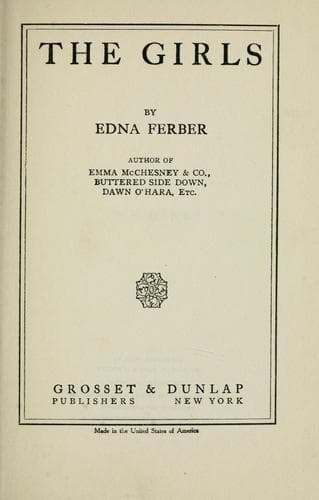
Chicago (Ill.) -- Fiction; Families -- Fiction; Women -- Fiction; World War, 1914-1918 -- Fiction
"I understand that Ben Gartz is going into that business he spoke
of last spring. Men's wrist watches. We all thought he was making a
mistake but it seems he's right. He's going in with Beck and Diblee
this fall. I shouldn't wonder if Ben Gartz should turn out to be a very
rich man some day. A ve-ry rich man. Especially if this war----"
"That'll be nice," said Lottie.
"I wish Henry had some of his push and enterprise."
Lottie looked up quickly at that, prompt in defense of Henry. "Henry
isn't to blame for the war. His business was successful enough until
two years ago--more than successful. It just happens to be the kind
that has been hardest hit."
"Why doesn't he take up a new business, then! Ben Gartz is going into
something new."
"Ben's mother left him a little money when she died. I suppose he's
putting that into the new business. Besides, he hasn't a family to
think of. He can take a chance. If it doesn't turn out he'll be the
only one to suffer."
"Ben Gartz is an unusual boy." (Boy!) "He was a wonderful son to his
mother.... I'd like to know what you have against him."
"Against him! Why, not a thing, mama. Only----"
Lottie hesitated. Then, regrettably, she giggled. "Only he has never
heard of Alice in Wonderland, and he thinks the Japs are a wonderful
little people but look out for 'em!, and he speaks of summer as the
heated term, and he says 'not an iota.'"
"Not an iota!" echoed Mrs. Payson almost feebly.
"Yes. You know--'not an iota of truth in it'; 'not an iota of
difference.'"
"Lottie Payson, sometimes I think you're downright idiotic! Alice in
Wonderland! The idea! Woman your age! Ben Gartz is a business man."
"Indeed he is--strictly."
"I suppose you'd prefer going around with some young fool like this
poet Charley has picked up from behind the delicatessen counter. I
don't know what your sister Belle can be thinking of."
Sister Belle was thinking of a number of things, none of them pleasant;
and none of them connected with Charley or Charley's poet. Henry Kemp
had sold the car--the big, luxurious, swift-moving car. He had hinted
that the nine-room apartment on Hyde Park Boulevard might soon be
beyond his means.
"If this keeps up much longer," he had said one day to Charley, "your
old dad will be asking you for a job as bundle boy at Shield's." His
laugh, as he said it, had been none too robust.
Charley had been promoted from stock-girl to saleswoman. She said she
supposed now she'd have to save up for black satin slippers, a French
frock, a string of pearls, and filet collars and cuffs--the working
girl's costume. She announced, further, that her education had reached
a point where any blouse not hand made and bearing a thirty-nine dollar
price tag was a mere rag in her opinion.
Public-domain text, read in full here on John Shaqi.
Reviews
Reviews
No reviews yet
Be the first to share your thoughts on this work.
Elsewhere in the archive
Join the Discussion
Join the discussion
Sign in to leave a comment or review.
Sign InorCreate an account