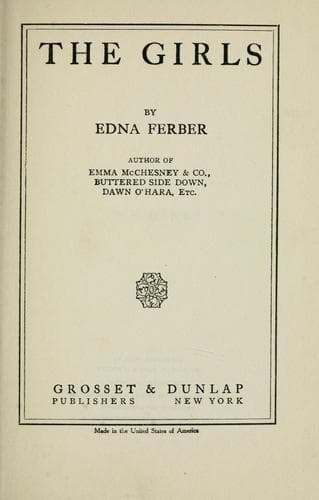
Chicago (Ill.) -- Fiction; Families -- Fiction; Women -- Fiction; World War, 1914-1918 -- Fiction
Charley's Saturday afternoons and Sundays were spent in the country
about Chicago--at the Indiana sand dunes; at Palos Park when May
transformed its trees into puff-balls of apple blossoms; in the woods
about Beverly; along the far North Shore. Both she and Lottie were
hardened trampers. Lottie was expert at what she called "cooking out."
She could build a three-section fire with incredibly little fuel and
only one match. Just as you were becoming properly ravenous she had
the coffee steaming in one section, the bacon sizzling in another,
the sausages boiling in another. Now that the Kemp car was gone these
country excursions became fewer for Lottie. She missed them. The
electric was impossible for country travel. It often expired even on
the boulevards and had to be towed back to the garage. Charley said
that Jesse Dick's flivver saved her life and youth these spring days.
Together they ranged the countryside in it, a slim volume of poetry
(not his own) in Jesse Dick's pocket and a plump packet of sandwiches
and fruit in a corner of the seat. You were beginning to see reviews of
Jesse Dicks' poems in _The Dial_, in the _New Republic_, in
the weekly literary supplements of the newspapers. They spoke of his
work as being "virile and American." They said it had a "warm human
quality." He sang everyday life--the grain-pit, the stockyards, the
steel mill, the street corner, the movies. Some of the reviews said,
"But this isn't poetry!" Perhaps they had just been reading the thing
he called "Halsted Street." You know it:
Halsted street. All the nations of the world.
Mill end sales; _shlag_ stores; Polack women gossiping.
Look at the picture of the bride in her borrowed wedding dress
Outside the Italian photograph gallery----
Perhaps they were right.
Still, while he did not write spring poetry of the May-day variety it
is certain that not a peach-pink petal on a wild-crab tree blossoming
by the roadway bloomed in vain as Jesse and Charley passed by. Not
that they were rhapsodic about it. These two belonged to the new order
to whom lyricism was loathsome, adjective anathema. Fine and moving
things were received with a trite or even an uncouth word or phrase.
After a Brahms symphony you said, "Gee!" It was considered "hickey" or
ostentatious to speak of a thing as being exquisite or wonderful. They
even revived that humourously vulgar and practically obsolete word,
"swell." A green and gold and pink May-day landscape was "elegant."
Struck by the beauty of a scene, the majesty of a written passage, the
magnificence of the lake in a storm, the glory of an orchard in full
bloom, they used the crude and rustic "Gosh!" This only when deeply
stirred.
Late in May, Ben Gartz bought a car of unimpressive make but florid
complexion. He referred to it always as "the bus." As soon as he had
mastered it he drove round to the Paysons' and proposed a Sunday
morning ride to Lottie.
"Go on, Lottie," Mrs. Payson said, "it'll do you good."
Public-domain text, read in full here on John Shaqi.
Reviews
Reviews
No reviews yet
Be the first to share your thoughts on this work.
Elsewhere in the archive
Join the Discussion
Join the discussion
Sign in to leave a comment or review.
Sign InorCreate an account