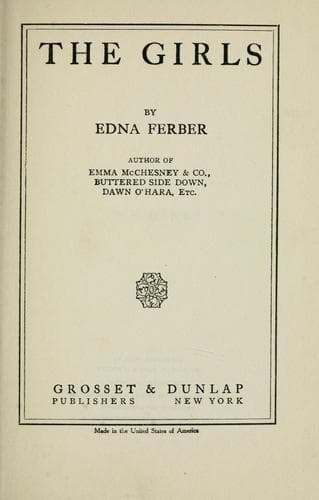
Chicago (Ill.) -- Fiction; Families -- Fiction; Women -- Fiction; World War, 1914-1918 -- Fiction
Her mother looked at her. Charlotte raised her own tear-drenched face
that was so mutely miserable, so stricken, so dumbly questioning.
Marred as it was, and grief-ravaged, Mrs. Thrift seemed still to find
there something that relieved her. She said more gently, perhaps, than
in any previous questioning:
"Why did you do it, Charlotte?"
"I couldn't help it. I couldn't help it."
Isaac Thrift snorted impatiently. Hetty Thrift compressed her lips a
little and sighed. "Yes, but why did you do it, Charlotte? Why? You
have been brought up so carefully. How could you do it?"
Now, the answer that lay ready in Charlotte's mind was one that could
have explained everything. And yet it would have explained nothing;
at least nothing to Hetty and Isaac Thrift. The natural reply on
Charlotte's tongue was simply, "Because I love him." But the Thrifts
did not speak of love. It was not a ladylike word. There were certain
words which delicacy forbade. "Love" was one of them. From the manner
in which they shunned it--shrank from the very mention of it--you might
almost have thought it an obscenity.
Mrs. Thrift put a final question. She had to. "Had you ever kissed him
before?"
"Oh, no!" cried Charlotte so earnestly that they could not but believe.
Then, quiveringly, as one bereaved, cheated, "Oh, no! No! Never! Not
once.... Not once."
The glance that Mrs. Thrift shot at her husband then was a mingling of
triumph and relief.
Isaac Thrift and his wife did not mean to be hard and cruel. They had
sprung from stern stock. Theirs was the narrow middle-class outlook of
members of a small respectable community. According to the standards of
that community Charlotte Thrift had done an outrageous thing. War, in
that day, was a grimmer, though less bloody and wholesale, business
than it is to-day. An army whose marching song is Where Do We Go From
Here? attaches small significance to the passing kiss of an hysterical
flapper, whether the object of the kiss be buck private or general. But
an army that finds vocal expression in The Battle Cry of Freedom and
John Brown's Body is likely to take its bussing seriously. The publicly
kissed soldier on his way to battle was the publicly proclaimed
property of the kissee. And there in front of the Court House steps, in
full sight of her world--the Addison Canes, the Thomas Holcombs, the
Lewis Fullers, the Clapps--Charlotte Thrift, daughter of Isaac Thrift,
had run after, had thrown her arms about, and had kissed a young man
so obscure, so undesirable, so altogether an unfitting object for a
gently-bred maiden's kisses (public or private) as to render valueless
her kisses in future.
Public-domain text, read in full here on John Shaqi.
Reviews
Reviews
No reviews yet
Be the first to share your thoughts on this work.
Join the Discussion
Join the discussion
Sign in to leave a comment or review.
Sign InorCreate an account