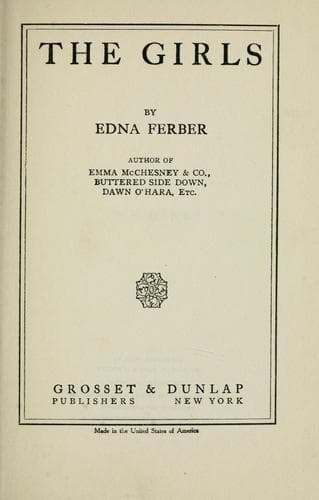
Chicago (Ill.) -- Fiction; Families -- Fiction; Women -- Fiction; World War, 1914-1918 -- Fiction
The relationship between Charlotte, Lottie, and Charley is a simple
one, really, though having, perhaps, an intricate look to the outsider.
Great-aunt, niece, grand-niece: it was understood readily enough in
Chicago's South Side, just as it was understood that no one ever called
Lottie "Charlotte," or Charley "Lottie," though any of the three might
be designated as "one of the Thrift girls."
The Thrifts had been Chicago South Siders since that September in 1836
when Isaac Thrift had traveled tediously by rail, Sound steamer, river
boat, canal boat, lake ship, and horse wagon from his native New York
State to the unkempt prairie settlement on the banks of the sluggish
stream that the Pottawatamie Indians called Che-ca-gou. Their reason
for having thus named a city after the homely garlic plant was plain
enough whenever the breeze came pungently from the prairies instead of
from Lake Michigan.
Right here is the start of Aunt Charlotte. And yet the temptation
is almost irresistible to brush rudely past her and to hurry on to
Lottie Payson, who is herself hurrying on home through the slate and
salmon-pink Chicago sunset after what is known on the South Side as
"spending the afternoon."
An exhilarating but breathless business--this catching up with Lottie;
Lottie of the fine straight back, the short sturdy legs, the sensible
shoes, the well-tailored suit and the elfish exterior. All these items
contributed to the facility with which she put the long Chicago blocks
behind her--all, that is, except the last. An unwed woman of thirty-odd
is not supposed to possess an elfish exterior; she is expected to
be well-balanced and matter-of-fact and practical. Lottie knew this
and usually managed to keep the imp pretty well concealed. Yet she
so often felt sixteen and utterly irresponsible that she had to take
brisk walks along the lake front on blustery days, when the spray
stung your cheeks; or out Bryn Mawr way or even to Beverly Hills where
dwellings were sparse and one could take off one's hat and venture
to skip, furtively, without being eyed askance. This was supposed to
help work off the feeling--not that Lottie wanted to work it off.
She liked it. But you can't act Peter Pannish at thirty-two without
causing a good deal of action among conservative eyebrows. Lottie's
mother, Mrs. Carrie Payson, would have been terribly distressed at
the thought of South Side eyebrows elevated against a member of her
household. Sixty-six years of a full life had taught Mrs. Carrie Payson
little about the chemistry of existence. Else she must have known
how inevitably a disastrous explosion follows the bottling up of the
Lotties of this world.
Public-domain text, read in full here on John Shaqi.
Reviews
Reviews
No reviews yet
Be the first to share your thoughts on this work.
Join the Discussion
Join the discussion
Sign in to leave a comment or review.
Sign InorCreate an account