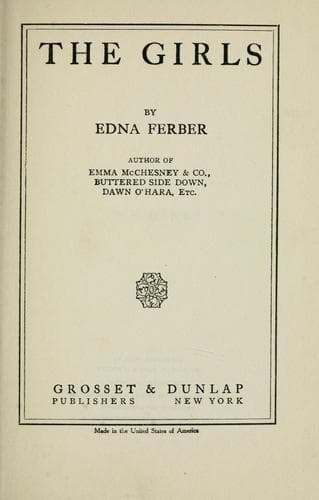
Chicago (Ill.) -- Fiction; Families -- Fiction; Women -- Fiction; World War, 1914-1918 -- Fiction
"How are they this morning?... Again!... Well then give her a little
oil.... Certainly not! I didn't have the doctor in every time you two
girls had a little something wrong.... Oh, you're always having that
baby specialist in every time she makes a face. We never heard of baby
specialists when I was a.... Well, but the oil won't hurt her.... If
they're not normal by to-morrow get him but.... You won't be able to go
to the luncheon, of course.... You are! But if Charley's.... Well, if
she's sick enough to have a doctor she's sick enough to need her mother
at home.... Oh, all right. Only, if anything happens.... How was the
chicken you bought yesterday?... Didn't I tell you it was a tough one!
You pay twice as much over there in Hyde Park.... What are you going to
wear to the luncheon?..."
Throughout her school years Lottie had always had a beau to squire
her about at school parties and boy-and-girl activities. He was
likely to be a rather superior beau, too. No girl as clear-headed as
Lottie, and as intelligently fun-loving and merry, would tolerate
a slow-witted sweetheart. The word sweetheart is used for want of
a better. Of sweethearting there was little among these seventeen-
and eighteen-year-olds. Viewed through the wise eyes of to-day's
adolescents they would have seemed as quaint and stiff as their
pompadours and high collars.
In a day when organised Social Work was considered an original and
rather daring departure for women Lottie Payson seemed destined by
temperament and character to be a successful settlement worker. But she
never became one. Lottie had too much humour and humaneness for the
drab routine of school-teaching; not enough hardness and aggressiveness
for business; none of the creative spark that marks the genius in
art. She was sympathetic without being sentimental; just and fair
without being at all stern or forbidding. Above all she had the gift of
listening. The kind of woman who is better-looking at thirty-five than
at twenty. The kind of woman who learns with living and who marries
early or never. With circumstance and a mother like Mrs. Carrie Payson
against her, Lottie's chances of marrying early were hardly worth
mentioning. Lottie was the kind of girl who "is needed at home."
Public-domain text, read in full here on John Shaqi.
Reviews
Reviews
No reviews yet
Be the first to share your thoughts on this work.
Join the Discussion
Join the discussion
Sign in to leave a comment or review.
Sign InorCreate an account