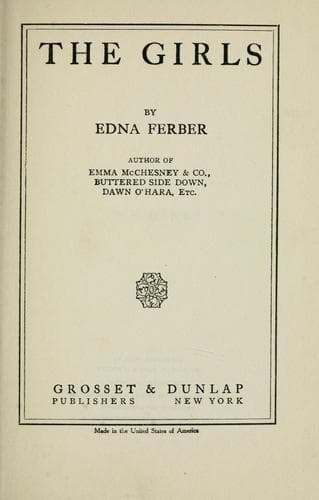
Chicago (Ill.) -- Fiction; Families -- Fiction; Women -- Fiction; World War, 1914-1918 -- Fiction
"How about mother, slaving down in that office all day, when all the
other women of her age are taking it easy--a nap at noon, and afternoon
parties, and a husband to work for them?"
"Slaving fiddlesticks! She likes it. Your mother'd rather read the real
estate transfers than a novel. Besides, she doesn't need to. We could
live on the rents. Nothing very grand, maybe. But we could live. And
why not let you do something? That's what I'd like to know! Why not----"
"Oh, I'd love it. All the girls--that is, all the girls I like--are
doing some kind of work. But mother says----"
Aunt Charlotte sniffed. It was almost a snort. "I know what your mother
says. 'No daughter of mine is going to work for her living.' Hmph!"
(Which is not expressing it, but nearly.) "Calls herself modern. She's
your grandfather over again and he thought he was a whole generation
ahead of his generation. Wasn't, though. Little behind, if anything."
Sometimes Aunt Charlotte, the subdued, the vaguely wistful, had a
sparkling pugnacity, a sudden lift of spirits that showed for a
brief moment a glimpse of the girl of fifty years ago. A tiff with
Carrie Payson (in which Charlotte, strangely enough, usually came off
victorious) often brought about this brief phenomenon. At such times
she had even been known to sing, in a high off-key falsetto, such
ghostly, but rakish, echoes as: Champagne Charley Was His Name, or,
Captain Jinks of the Horse Marines, or even, Up in a Balloon Boys.
Strangely enough as she grew older this mood became more and more
familiar. It was a sort of rebirth. At times she assumed an almost
jaunty air. It was as though life, having done its worst, was no longer
feared by her.
In spite of objections, Lottie made sporadic attempts to mingle in the
stream of life that was flowing so swiftly past her--this new life of
service and self-expression into which women were entering. Settlement
work; folk dancing, pageantry, juvenile and girls' court work; social
service; departmental newspaper work. Lottie was attracted by all of
these and to any one of them she might have given valuable service. A
woman, Emma Barton, not yet fifty, had been appointed assistant judge
of the new girls' court. No woman had held a position such as that.
Lottie had met her. The two had become friends--close friends in spite
of the disparity in their ages.
"I need you so badly up here," Emma Barton often told Lottie. "You've
got a way with girls; and you're not school-teachery or judicial with
them. That's the trouble with the regular court worker. And they talk
to you, don't they? Why, I wonder?
"Maybe it's because I listen," Lottie replied. "And they think I'm sort
of simple. Maybe I am. But not so simple as they think." She laughed.
A visit to Judge Barton's court always stimulated her, even while it
saddened.
Public-domain text, read in full here on John Shaqi.
Reviews
Reviews
No reviews yet
Be the first to share your thoughts on this work.
Join the Discussion
Join the discussion
Sign in to leave a comment or review.
Sign InorCreate an account