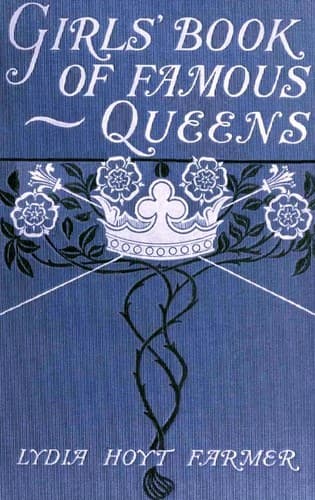
The Girls' Book of Famous QueensFarmer, Lydia Hoyt
History
The Girls' Book of Famous Queens
Farmer, Lydia Hoyt
Queens -- Biography -- Juvenile literature
The life of the woman who had supplanted her was short and full
of sorrow. Three years only elapsed after Henry had married Anne
Boleyn, and only four months after Catharine had sent him her dying
forgiveness, when her exulting rival met her awful doom.
Already had King Henry cast his eyes upon Jane Seymour, and on the 15th
of May, 1536, the sentence upon the queen was pronounced. Wolsey, who
had suggested and aided the divorce of Catharine, had fallen under the
disfavor of Anne, and through her influence he was overthrown and died
in disgrace. And now Anne herself was to suffer the penalty of her
wicked ambition. On the 19th of May, 1536, Anne Boleyn was led out upon
Tower Green, and a blow from the executioner ended her eventful, but
brief life.
“It is done!” cried the inhuman Henry, as he heard the cannon which was
the signal that the tragedy was over; “that is an end of the matter.
Unleash the dogs, and let us follow the stag.”
Thus ended the life of Anne Boleyn, and on the next day King Henry
VIII. was married to his third wife, Jane Seymour.
QUEEN ELIZABETH, AND MARY, QUEEN OF SCOTS.
A.D. 1533-1603.
“A crown
Golden in show, is but a wreath of thorns,
Brings dangers, troubles, cares, and sleepless nights
To him who wears the regal diadem.”—MILTON.
“One speaks the glory of the British Queen,
And one describes a charming Indian screen;
A third interprets motions, looks, and eyes;
At every word a reputation dies.”—POPE.
THE lives of Queen Elizabeth, and Mary, Queen of Scots, are so
intimately associated, that a sketch of one includes that of the other;
and in order to give the history of that epoch with greater conciseness
and clearness without unnecessary repetition, a brief outline of each
of their lives is here sketched.
For the sake of perspicuity, a few lines will be given to intervening
events.
As we stated in the account of Catharine of Aragon, Henry VIII. married
Jane Seymour upon the day following the execution of Anne Boleyn.
Fortunately for Jane Seymour, death removed her during the succeeding
year, rather than the fatal axe of her royal husband. She left an
infant prince, who afterwards reigned a few short years as Edward VI.
[Illustration: QUEEN ELIZABETH
Painting by Frd. Zucchero, “so-called Ermine portrait,” in the
possession of the Marquis of Salisbury, Hatfield House.]
Public-domain text, read in full here on John Shaqi.
Reviews
Reviews
No reviews yet
Be the first to share your thoughts on this work.
Elsewhere in the archive
Join the Discussion
Join the discussion
Sign in to leave a comment or review.
Sign InorCreate an account