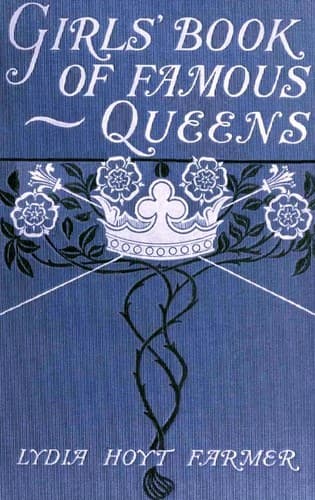
The Girls' Book of Famous QueensFarmer, Lydia Hoyt
History
The Girls' Book of Famous Queens
Farmer, Lydia Hoyt
Queens -- Biography -- Juvenile literature
To amuse her gouty, quarrelsome, would-be-literary and
spasmodically-religious royal spouse, Queen Catherine ventured to argue
with him upon certain points in theology. Finding himself worsted in
the mental contest, the irate king exclaimed: “A good hearing this,
when women become such clerks; and a thing much to my comfort to
come in my old age to be taught by my wife.” And thereupon the new
chancellor received the order to prepare the impeachment of the queen.
But Catherine was warned in time of her coming doom and was possessed
of self-control and tact sufficient for this emergency. When again the
conversation turned upon religious subjects and the king questioned her
upon some knotty point, she answered laughing: “I am not so foolish as
not to know what I can understand when I possess the favor of having
for a master and spouse a prince so learned in holy matters.”
“By St. Mary!” exclaimed the king; “it is not so, Kate; thou hast
become a doctor.”
“And surely,” quoth the queen with mirthful looks, “I thought I noticed
that such conversation diverted your Grace’s attention from your
sufferings, and I ventured to discuss with you in the hope of making
you forget your present infirmity.”
“Is it so, sweetheart?” replied the king; “then we are friends again,
and it doth me more good than if I had received a hundred thousand
pounds.”
The skilful and politic queen, well pleased to find her lovely head
still resting on her own shoulders instead of on the executioner’s
block, gave thanks to God for her deliverance, and henceforth left
theology in peace. The orders given to the chancellor not having been
revoked, the next day he arrived with forty men to arrest the queen,
but King Henry, feigning surprise and anger, sent him away with much
apparent displeasure.
Thus had Queen Catherine’s wit saved her neck, and the strong grip of
the increasing gout now came to her rescue, and this Prince of Shams
soon found himself held in the clutch of such a sturdy foe that neither
qualms of conscience, nor tears, nor threats, could rid him at last
of this dread consort of the tomb. Death claimed him, and the royal
hypocrite was forced to yield to that relentless conqueror; and Henry
VIII. faced the awful tribunal where no pretensions or shams could
avail to hide the horrid deformity of his sin-polluted soul.
Upon the death of Henry VIII. in 1547, his son Edward was proclaimed
king as Edward VI. But this young king died in 1553, at the age of
sixteen years, and the mighty realm of England was left to the
conflicting succession of two princesses, both of whom their royal
father had stigmatized with the ban of illegitimacy. In this emergency
the Protestants, headed by the Duke of Northumberland, determined to
set up a new claimant.
Public-domain text, read in full here on John Shaqi.
Reviews
Reviews
No reviews yet
Be the first to share your thoughts on this work.
Elsewhere in the archive
Join the Discussion
Join the discussion
Sign in to leave a comment or review.
Sign InorCreate an account