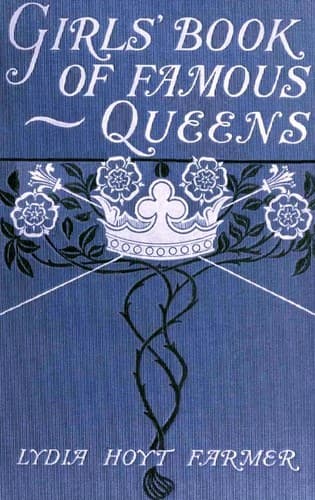
The Girls' Book of Famous QueensFarmer, Lydia Hoyt
History
The Girls' Book of Famous Queens
Farmer, Lydia Hoyt
Queens -- Biography -- Juvenile literature
The Princess Mary evinced great regard for her sister Elizabeth; and
when the brutal King Henry deposed both these princesses from their
rights of succession, and stigmatized them as illegitimate, and sent
word to Mary that she should no longer treat Elizabeth as princess,
Mary wrote a letter to her father, the king, in which she kindly
mentioned Elizabeth thus: “My sister Elizabeth is in good health, and
such a child, too, as I doubt not but your Highness shall have cause to
rejoice of in time coming.”
Anne of Cleves was granted permission to see Elizabeth, even after
her divorce, providing Elizabeth did not address her as queen; and
all of the wives of Henry VIII. evinced great love for the Princess
Elizabeth; and through the influence of Catherine Parr, Henry VIII.
restored Elizabeth to her right of succession, although the act which
pronounced her illegitimate remained forever unrepealed; and after she
had become queen of England, she refrained from requiring Parliament to
repeal those acts of her father which had declared his marriage with
Anne Boleyn null and void; and she contented herself with an act of
Parliament which declared in general terms her rights of succession to
the throne.
While the youthful Edward VI. was king, the Princess Elizabeth was
involved in certain questionable relations with the Lord High Admiral
Seymour, who had married the Queen-Dowager Catherine, a few weeks after
the death of Henry VIII.
Upon the death of Catherine, a year afterwards, Lord High Admiral
Seymour aspired to the hand of the Princess Elizabeth. There is no
doubt that Elizabeth loved Seymour; and, as she acknowledged, would
have married him if the consent of the royal executors could have been
obtained; but as such an alliance was considered beneath her, Elizabeth
was shut up for a time in a sort of imprisonment, and the lord high
admiral was conveniently disposed of by being led to the scaffold.
It is amusing to note that the hand of this much-courted and
confirmed-spinster queen was once offered by Henry VIII. to a Scottish
earl of equivocal birth and indifferent reputation, who actually
declined the honor. But Elizabeth, when queen of England, proudly
refused earls, dukes, and even kings, though it must be confessed she
served the king of Sweden, who was one of her most constant suitors,
rather meanly; for this royal lover sent her a magnificent present
consisting of eighteen large piebald horses, and two ships’ loads of
the most precious articles his country could produce, which princely
gift Elizabeth most graciously received, but wrote to this ardent
lover, that she anxiously hoped he would spare himself the fatigues
of a fruitless voyage,—rather strange royal etiquette, to receive the
suitor’s gift and then reject the giver.
Regarding Elizabeth’s mental acquirements, her learned preceptor, Roger
Ascham, thus wrote:—
Public-domain text, read in full here on John Shaqi.
Reviews
Reviews
No reviews yet
Be the first to share your thoughts on this work.
Elsewhere in the archive
Join the Discussion
Join the discussion
Sign in to leave a comment or review.
Sign InorCreate an account