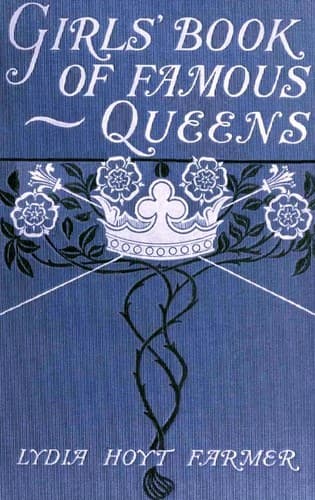
The Girls' Book of Famous QueensFarmer, Lydia Hoyt
History
The Girls' Book of Famous Queens
Farmer, Lydia Hoyt
Queens -- Biography -- Juvenile literature
“The Lady Elizabeth hath accomplished her sixteenth year; and so much
solidity of understanding, such courtesy united with dignity, have
never been observed at so early an age. She has the most ardent love
of true religion and of the best kind of literature. The constitution
of her mind is exempt from female weakness, and she is endued with a
masculine power of application. No apprehension can be quicker than
hers, no memory more retentive. French and Italian she speaks like
English; Latin with fluency, propriety, and judgment; she also speaks
Greek with me frequently, willingly, and moderately well. Nothing
can be more elegant than her handwriting, whether in Greek or Roman
characters. In music she is very skilful, but does not greatly delight.
With respect to personal decoration, she greatly prefers a simple
elegance to show and splendor, so despising the outward adorning of
plaiting the hair and of wearing gold, that in the whole manner of her
life she rather resembles Hippolita than Phœdra.
“She read with me almost the whole of Cicero and a great part of Livy;
from these two authors, indeed, her knowledge of the Latin language has
been almost exclusively derived. The beginning of the day was always
devoted by her to the New Testament in Greek, after which she read
select portions of Isocrates, and the tragedies of Sophocles, which
I judged best adapted to supply her tongue with the purest diction,
her mind with the most excellent precepts, and her exalted station
with a defence against the utmost power of fortune. For her religious
instruction she drew first from the fountains of Scripture, and
afterwards from St. Cyprian, Melancthon, and similar works. In every
kind of writing she easily detected any ill-adapted or far-fetched
expression. By a diligent attention to these particulars, her ears
became so practised and so nice that there was nothing in Greek, Latin,
or English, prose or verse, which, according to its merits or defects,
she did not either reject with disgust or receive with the highest
delight.”
After the accession of Mary to the throne, the Wyatt rebellion
took place: and as it was reported that the Princess Elizabeth was
implicated, she was confined for three months in the Tower. Elizabeth
was then conveyed to Woodstock, where she endured a less rigorous
imprisonment. Her correspondence was carefully watched, and it was
with great difficulty that she succeeded at length in appealing to
the queen. It was at this time that she wrote upon her window with a
diamond the following lines:—
“Much suspected, of me
Nothing proved can be,
Quoth Elizabeth prisoner.”
As her Protestant proclivities were well known, when by the marriage
of Mary to Philip of Spain, Popedom was re-established in England,
Elizabeth thought it policy to attend the confessional; and upon
one occasion being asked what was her belief regarding the “blessed
sacrament,” she gave this famous and ambiguous answer:—
Public-domain text, read in full here on John Shaqi.
Reviews
Reviews
No reviews yet
Be the first to share your thoughts on this work.
Elsewhere in the archive
Join the Discussion
Join the discussion
Sign in to leave a comment or review.
Sign InorCreate an account