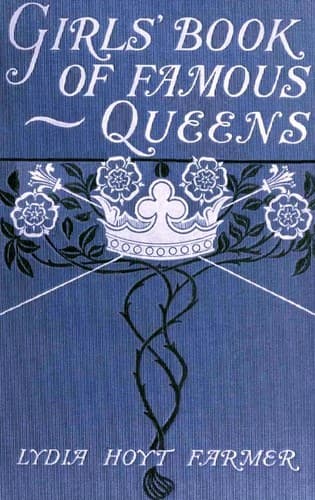
The Girls' Book of Famous QueensFarmer, Lydia Hoyt
History
The Girls' Book of Famous Queens
Farmer, Lydia Hoyt
Queens -- Biography -- Juvenile literature
The rise of English manufacture is dated from the reign of Queen
Elizabeth. The first paper-mill was set up in 1590, and watches and
coaches were first introduced into England during her reign. “When we
hear of Elizabeth riding to the House of Peers on a pillion in the
beginning of her reign, we should not forget that towards the close of
it she is represented as taking an airing in her coach every day.”
“The daily ceremonial of her court was distinguished by ‘Oriental
servility.’ Her table was served kneeling, and with as many
genuflections as would have contented the Emperor of China. Even her
ministers never addressed her but on their knees. From this slavish
ceremony Lord Burleigh was latterly excused, when age and infirmities
had rendered it painful or rather impracticable; but he was the only
exception.”
It has been said “that Elizabeth never forgot the woman in the
sovereign; and that with greater truth she never forget the sovereign
in the woman.” Poor praise, truly! without heart, without capacity for
any kindliness or womanly tenderness, she lived without a friend and
died without a mourner. Courtiers grovelled in fawning servility at
her feet, women feared her; but no one loved her, and even those who
flattered her despised her.
Of her two celebrated favorites, Leicester and Essex, the first was
perfidious and utterly worthless; the latter was too manly to bear her
insolence, and for that he lost his head. He was too spirited to cringe
at her footstool, and when on one occasion she angrily boxed his ear,
he exclaimed, in indignation, “I would not have taken such an affront
from the hands of the king, her father, and I will not accept it of
a petticoat! I owe her Majesty the duty of an earl, but I will never
serve her as a slave!”
But nevertheless, the petticoat would not be opposed, and Essex
perished on the fatal block, even though his death wrung the small
heart Elizabeth possessed with all the sorrow it was capable of
feeling. She had given Essex a ring in the time of his influence,
telling him, if ever he was in danger to send it to her and she would
aid him. When he was sentenced to die, he sent Queen Elizabeth this
ring, but it passed through the hands of a court lady whose husband was
Essex’s deadly foe. The ring never reached the queen, and Essex was
executed. Years after, when this countess was dying she confessed the
fate of the ring to the queen. The sorrow and remorse which Elizabeth
experienced on knowing that her favorite had thus appealed to her
mercy, hastened her own death.
Public-domain text, read in full here on John Shaqi.
Reviews
Reviews
No reviews yet
Be the first to share your thoughts on this work.
Elsewhere in the archive
Join the Discussion
Join the discussion
Sign in to leave a comment or review.
Sign InorCreate an account