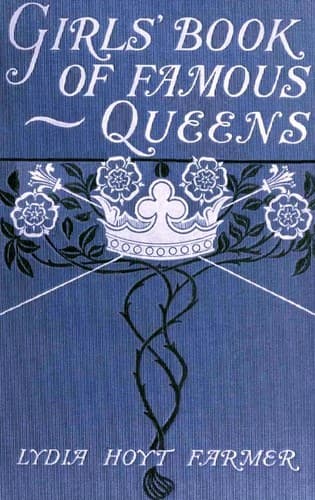
The Girls' Book of Famous QueensFarmer, Lydia Hoyt
History
The Girls' Book of Famous Queens
Farmer, Lydia Hoyt
Queens -- Biography -- Juvenile literature
It was during the reign of Queen Elizabeth that Sir Francis Drake
accomplished the journey around the world and Sir Walter Raleigh made
his famous voyages. Tobacco was first introduced into England by him.
An amusing story is told of the first use of the weed. He was smoking
a pipe one day, when his servant came into the room bearing a tankard
of ale. The simple fellow had never before witnessed the process of
smoking, and supposing that the clouds of smoke issuing from his
master’s lips betokened some awful accident, he flung the ale into his
face and ran from the room, crying that his master was on fire and
would be burned to ashes if they did not come to his aid.
Raleigh once amused the queen by making a wager with her that he could
tell her the exact weight of the smoke of every pipeful of tobacco
that he consumed. The wager was accepted by the queen, and Raleigh
thereupon proceeded to weigh the tobacco he placed in his pipe, and,
after smoking, he weighed the ashes remaining, and informed her that
the difference between the two was the exact weight of the smoke.
Elizabeth paid the wager, saying: “That she knew of many persons who
had turned their gold into smoke, but that he was the first one who had
turned smoke into gold.” The well-known gallantry of this same Raleigh
in spreading his new velvet cloak over the muddy walk for his royal
mistress to tread upon, not only secured him many new cloaks, but the
powerful patronage of the queen.
It was to Queen Elizabeth that the poet Spenser dedicated his poetical
muse, and in his “Faerie Queene” he celebrated and exalted his
sovereign. But the greatest name of her reign, and the one which has
shed the brightest and most lasting lustre upon the Elizabethan age,
was the illustrious Shakespeare. It is stated that the “Merry Wives of
Windsor” was composed by order of Queen Elizabeth, who, having been
pleased with Falstaff, in the play of “Henry IV.,” desired to see more
of him. It is supposed that between 1590 and 1603 Shakespeare produced
the plays of “Venus and Adonis,” “Two Gentlemen of Verona,” “Love’s
Labor Lost,” “Taming of the Shrew,” “Henry IV., V., VI. and VIII.,”
“Midsummer-Night’s Dream,” “Hamlet,” “Richard II. and III.,” “Romeo and
Juliet,” “King John,” “As You Like It,” “Merchant of Venice,” “All’s
Well that Ends Well,” “Much Ado About Nothing,” and “Merry Wives of
Windsor”; and before 1606: “Troilus and Cressida,” “Othello,” “Twelfth
Night,” “Measure for Measure,” “Comedy of Errors,” “King Lear,” and
“Macbeth.” So that nearly all of these works appeared in the reign of
Elizabeth, who died in 1603.
Elizabeth’s contest against Philip II. of Spain, in assisting the Dutch
in their war against Spanish tyranny, was one of the most illustrious
of her foreign enterprises. In this war of liberty against despotism,
Elizabeth’s bravest commanders and most accomplished courtiers
distinguished themselves.
Public-domain text, read in full here on John Shaqi.
Reviews
Reviews
No reviews yet
Be the first to share your thoughts on this work.
Elsewhere in the archive
Join the Discussion
Join the discussion
Sign in to leave a comment or review.
Sign InorCreate an account