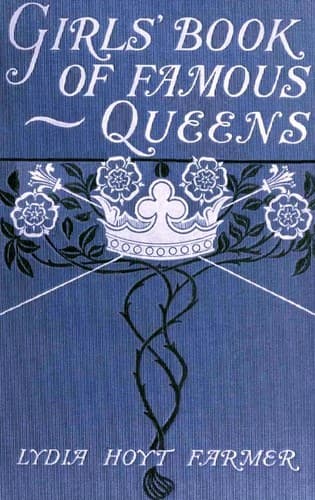
The Girls' Book of Famous QueensFarmer, Lydia Hoyt
History
The Girls' Book of Famous Queens
Farmer, Lydia Hoyt
Queens -- Biography -- Juvenile literature
“It was the injustice of Henry VIII.’s will in ignoring the descendants
of his eldest sister, and placing those of the youngest in the order
of the regal succession next his own children, which rendered it
expedient for Mary, Queen of Scots, afterwards to obtain a recognition
of her rights from Elizabeth, although in point of legitimacy, Mary’s
lineal title to the throne of England was considered by all the Roman
Catholics in Europe, and the people still attached to that communion in
England and Ireland, as more valid than that of Elizabeth. Elizabeth
had, however, been recognized by the Parliament of England as the
successor of her late sister, Queen Mary I., and solemnly accepted
by the realm on the day of her consecration as the sovereign. It was
therefore futile to urge in depreciation of her title the stigma which
her unnatural father’s declaration, her unfortunate mother’s admission,
and Cranmer’s sentence, had combined to pass upon her legitimacy,
for, according to the constitutional laws of England, the crown had
taken away all defects that might previously have existed. The demand
of Mary Stuart to be acknowledged as her successor was in itself the
strongest recognition of the unimpugnable nature of Elizabeth’s rights,
and therefore ought to have been met in a friendly spirit, instead
of being repelled in a manner which naturally inspired suspicions in
the mind of Mary, that Elizabeth intended to supersede her legitimate
claims in favor either of one of the descendants of the youngest
sister of Margaret Tudor, or to bring forward the Earl of Huntingdon,
great-grandson of George, Duke of Clarence.”
It was poor Mary Stuart’s first father-in-law, Henry II. of France,
who cost her her head, by prematurely declaring her queen of England,
in 1559, and it was largely owing to the base treacheries and plots of
her second father-in-law, the Earl of Lennox, that the net-work of vile
lies, and slanders were spread about her in Scotland, which afterwards
so fatally entrapped her, to which the weak and vacillating Darnley
lent himself by turns, and then repenting, sued for pardon, which the
forgiving Mary had no sooner granted, than he was again persuaded by
her enemies to betray her.
Public-domain text, read in full here on John Shaqi.
Reviews
Reviews
No reviews yet
Be the first to share your thoughts on this work.
Elsewhere in the archive
Join the Discussion
Join the discussion
Sign in to leave a comment or review.
Sign InorCreate an account