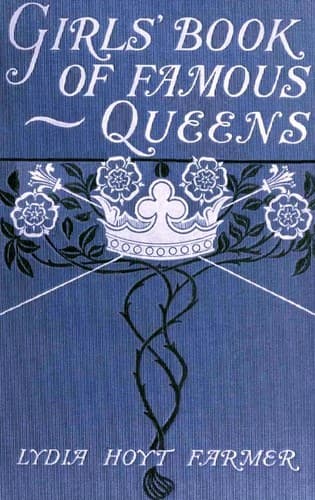
The Girls' Book of Famous QueensFarmer, Lydia Hoyt
History
The Girls' Book of Famous Queens
Farmer, Lydia Hoyt
Queens -- Biography -- Juvenile literature
Mary, Queen of Scots, returned to her native land after the death of
her husband, Francis II., and at this point Elizabeth’s injustice
begins. Mary sent a courteous request to the queen of England, that
she should be allowed to pass to her own kingdom through her cousin’s
domains; but this was ungraciously refused. After Mary, Queen of Scots,
reached Scotland and assumed royal power there, she was immediately
beset by suitors for her hand. The King of Sweden, Philip II. of Spain,
and the Archduke Charles, son of the Emperor of Germany, all sued for
her hand,—the former and latter in their own behalf, while Philip of
Spain desired an alliance between Mary and his heir, Don Carlos. As
these three princes had been previous suitors to the English queen,
Elizabeth never forgave the insult, and vented all her spite of wounded
vanity upon the poor Queen of Scots. Then followed the schemes and
intrigues regarding the marriage of the Scottish queen; Elizabeth
claiming that she had no right to marry any one whom she (Elizabeth)
did not approve. At length Mary took the matter into her own hands; and
being really in love with the handsome Darnley, her cousin,—who had
thus far veiled his weak and vicious nature beneath his courtly manners
and attractive face,—this unfortunate marriage was consummated, and
Mary Stuart became the hapless victim of her many enemies.
We cannot recount the details of the many trials heaped upon her by
her weak and unworthy husband and his intriguing father, joined with
Scottish noblemen, who desired her ruin because she was a Catholic.
These earls were not actuated by any fervent zeal in upholding the
Protestant religion; but as Scotland was then professedly a Protestant
nation, these wily nobles used the prevailing opinions of the people
to further their own ambitious schemes. And in denouncing Mary as a
Catholic, and urging that she be dethroned, that her infant son might
be declared king, they were simply endeavoring to grasp the reins of
government with their own hands. These Scottish noblemen were leagued
with the English court; but Bothwell headed another faction, which
explains the seeming difficulty in regard to her being still imprisoned
by the very party who rescued her from Bothwell’s power, and from whom
she was obliged to flee to England, to seek the promised protection of
the English queen.
With her last dying breath, Queen Elizabeth, perchance unwittingly,
substantiated her own treachery, or that of the English cabinet,
and acknowledged the rights of Mary, Queen of Scots. When urged to
name her successor, she said, “My seat has been the seat of kings,
and I will have _no rascal_ to succeed me.” Secretary Cecil ventured
to ask her what she meant by those significant words; to which she
replied,—thereby intimating that all who were not royal princes were
_perforce rascals_,—“I will be succeeded by a king, and who should that
be but the _King of Scots_.”
Public-domain text, read in full here on John Shaqi.
Reviews
Reviews
No reviews yet
Be the first to share your thoughts on this work.
Elsewhere in the archive
Join the Discussion
Join the discussion
Sign in to leave a comment or review.
Sign InorCreate an account