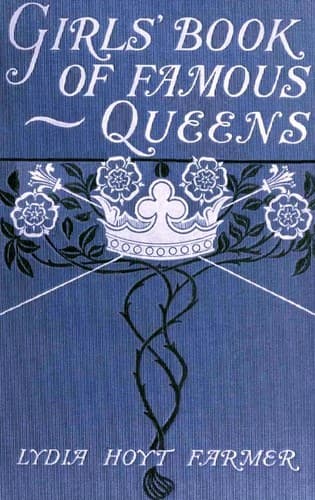
The Girls' Book of Famous QueensFarmer, Lydia Hoyt
History
The Girls' Book of Famous Queens
Farmer, Lydia Hoyt
Queens -- Biography -- Juvenile literature
In spite of the subtle schemes and wily plotting of the most cunning,
keen-witted, and unscrupulous courtiers of those wide-awake and
intellectually progressive times, all of them bent upon the destruction
of one helpless, imprisoned woman, whose very charms and fascinations
and confiding faith in good rather than evil motives, were used by
them as the very evidence to convict her of infamous guilt;—whereas,
these traits of character are the strongest proof of her innocence;—in
spite of all their evil machinations, aided by the jealous vanity of
a queen who in other respects evinced a strong mind, and whose reign
is regarded as one of the brightest epochs in the world’s history;
in spite of all these overwhelming forces conspiring to defame and
destroy the hapless Queen of Scots, nevertheless, our higher instincts
of humanity intuitively plead for the innocence of this unfortunate
Queen Mary, even though, by that very conclusion, we must perforce
tarnish the glory of the illustrious Queen of England. For Elizabeth’s
acknowledged defects of character harmonize more strongly with such
a supposition, than that we should, without violence to our better
intuitions, allow that it could be consistent to link with infamy and
crime Mary’s equally acknowledged loveliness and kindliness of nature,
and devout constancy to what _she_ felt to be vital points in her
Christian faith, while at the same time she allowed the most generous
liberality of belief to others. For of Mary, Queen of Scots, alone it
could be said, what no other sovereign of those days could claim, that
she never permitted persecution for religious differences.
That Elizabeth could be dissembling and treacherous when actuated
by her weak, jealous vanity, all historians fully prove and frankly
acknowledge; that Elizabeth scrupled not even at the death of her
former friends, when her petty spite was kindled against them, other
instances, such as the execution of the Earl of Essex, whom without
doubt Elizabeth loved, yet in a fit of anger condemned to death, most
clearly demonstrate. But that Mary, Queen of Scots, could display such
traits of character, as all testimony, whether that of friends or foes,
are forced to concede to her through long years of imprisonment, while
still at heart she was the infamous spirit of evil which her accusers
have declared her to be,—a very devil clothed in the likeness of an
angel of Paradise,—is against all experiences of human nature, against
all analogous instances in history.
Public-domain text, read in full here on John Shaqi.
Reviews
Reviews
No reviews yet
Be the first to share your thoughts on this work.
Elsewhere in the archive
Join the Discussion
Join the discussion
Sign in to leave a comment or review.
Sign InorCreate an account