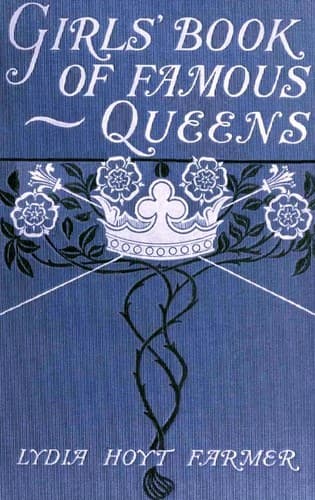
The Girls' Book of Famous QueensFarmer, Lydia Hoyt
History
The Girls' Book of Famous Queens
Farmer, Lydia Hoyt
Queens -- Biography -- Juvenile literature
The historians who defend Mary, Queen of Scots, claim that she was
innocent, not only of connivance at murder and infamous vice, but that
she was also free from all political intrigues, either in defence
of her ambitious greed for power, or in upholding her religious
fanaticism; while the historians who denounce Mary Stuart declare
that she was guilty of all and every crime, both as wife, woman, and
fanatic intriguer. From a close comparison of given evidence on both
sides, the truth would seem to lie between them; for the proofs seem
the stronger which free Mary, Queen of Scots, of connivance at murder,
and vile pollution, while probabilities lean toward the supposition
that she knew of, if she did not indeed encourage, plots amongst the
enemies of England; but as she was unjustly imprisoned by the English,
this was only political scheming; and though it might cost her her
head, from political expediency, it is no proof at all that she was
therefore guilty also of the most shocking and inexpiable corruption.
The plea of that _political expediency_ would of course remove infamy
from the English cabinet and their sovereign, as regards the one act
of decapitating their dangerous prisoner; but at the same time, the
same plea of political expediency would excuse the plotting of Mary,
Queen of Scots, while her substantiated innocence of the viler and more
heinous crimes brought against her character as a wife and a woman,
would at the same time heap upon the English government and Elizabeth
the deepest and most demoniacal infamy, in conniving at such atrocious
and brutal lies against the character and purity of a helpless woman,
that they might strengthen their political schemes against her life.
The question of the effect of her downfall upon the world, as regards
the upholding of Protestantism, and the check to the onrush of
inquisitorial Catholicism, is a very different matter from the question
regarding her innocence as a wife and a woman.
That her downfall strengthened Protestantism will be conceded; and
that her death from political expediency might have been required may
not be denied; which concession would not blot out the treachery of
Elizabeth and her ministers, nor would it involve the acknowledgment
of Mary Stuart’s guilt of aught save political plotting, which, had
she been the _queen_ on the _throne_ rather than the _queen_ in the
_prison_, would have been looked upon as justifiable strategy.
There is no doubt that the quarrel of Henry VIII. with the Pope and
Romish Church was a great factor in the glorious struggle for religious
liberty, and the strengthening of the power of the Reformation, which
has filled not only Europe, but the world, with the effulgent light
of a broader Christian civilization. But God can make the “very wrath
of man to praise him,” and because Henry VIII. was an unconscious and
unwilling instrument in the hands of the Almighty, the praise is not to
the wicked king, but to an overruling Providence.
Public-domain text, read in full here on John Shaqi.
Reviews
Reviews
No reviews yet
Be the first to share your thoughts on this work.
Elsewhere in the archive
Join the Discussion
Join the discussion
Sign in to leave a comment or review.
Sign InorCreate an account