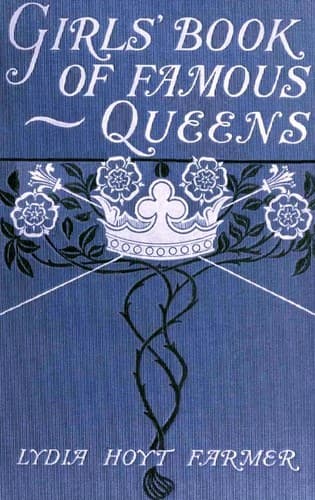
The Girls' Book of Famous QueensFarmer, Lydia Hoyt
History
The Girls' Book of Famous Queens
Farmer, Lydia Hoyt
Queens -- Biography -- Juvenile literature
The question of Mary Stuart’s guilt or innocence regarding the murder
of Darnley and willing marriage with Bothwell, is one thing; but the
question of Mary Stuart’s political intrigues with Elizabeth’s enemies
is entirely another thing. As regards Mary Stuart’s connivance with
her Catholic party during her long imprisonment in England, it is
not necessary that she should be proven innocent of such charges to
insure her innocence of the horrible infamy regarding the murder of
Darnley and willing marriage with his murderer. Were she guilty of
these nefarious crimes, all others however black and villanous would
be probable. But her innocence regarding those bloody deeds would not
be impeached by political intrigues to obtain her rightful liberty.
Political scheming was the governmental policy of the times, and he or
she who could be the most wily and intriguing _diplomate_ was looked
upon as one who had achieved the greatest stroke of genius. Surely in
this business none were such adepts as Elizabeth. That Mary Stuart
would plot in behalf of her Catholic belief would not prove that
she was capable of the vilest crimes. And though one should frankly
acknowledge that the death of Mary, Queen of Scots, was an advantage to
the cause of Protestantism, by weakening Catholicism in Scotland and
England, it would not consequently be necessary to prove that her death
was the evidence of any crime on her part, save the insatiate thirst
for power, and consequent scheming and plotting therefor, of which none
of the sovereigns of her time could be said to be guiltless.
Three things are asserted by those who condemn Mary, Queen of the
Scots: that she was guilty of murder, and the vilest crimes of which
a woman’s nature can be accused; that she was guilty of political
intrigues as a Catholic fanatic in behalf of her Roman faith; or that
she was without any religious belief, merely employing religion as a
cloak to her crimes. Now, of course, if she were guilty of the first
accusation, no one could attempt to deny the others; but though she
were guilty of both the last accusations, it would not imply that,
therefore, she was necessarily guilty of murder and revolting pollution.
Public-domain text, read in full here on John Shaqi.
Reviews
Reviews
No reviews yet
Be the first to share your thoughts on this work.
Elsewhere in the archive
Join the Discussion
Join the discussion
Sign in to leave a comment or review.
Sign InorCreate an account