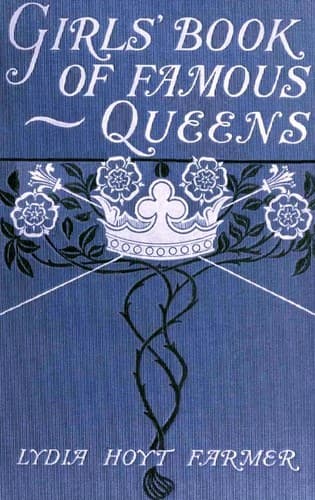
The Girls' Book of Famous QueensFarmer, Lydia Hoyt
History
The Girls' Book of Famous Queens
Farmer, Lydia Hoyt
Queens -- Biography -- Juvenile literature
At six o’clock on the fatal morning of the 8th of February, 1587,
Mary Stuart told her ladies that “she had but two hours to live, and
bade them dress her as for a festival.” The particulars of the last
_toilette_ have been preserved. “She wore a widow’s dress of black
velvet, spangled over with gold, a black satin pourpoint and kirtle,
and under these a petticoat of crimson velvet, with a body of the same
color, and a white veil of the most delicate texture, of the fashion
worn by princesses of the highest rank, thrown over her coif and
descending to the ground. She wore a pomander chain, and an _Agnus Dei_
about her neck, and a pair of beads at her girdle, with a cross.”
Mary Stuart had gained the reluctant consent of her inhuman jailers,
that her faithful ladies, Jane Kennedy and Elizabeth Curie, should
attend her in her last moments. This had been stoutly refused at first,
but the eloquent exclamation of the royal captive, “I am cousin to your
queen, descended of the blood-royal of Henry VII., a married queen of
France, and the anointed queen of Scotland!” at length shamed them into
granting this last request.
When the still-beautiful, heroic Mary Stuart entered the hall of death,
followed by her faithful attendants, she gazed upon the sable scaffold,
the dread block, the gleaming axe, and the revolting executioner, with
calm and undaunted courage, manifesting by her majestic and intrepid
demeanor, and the angelic sweetness of her countenance, that in spite
of calumny and hostile hosts of pitiless foes, Mary, Queen of Scots
could face the world and death undismayed.
[Illustration: MARY STUART LED TO EXECUTION
Drawing by Gyula Benczur.]
“Weep not, my good Melville!” said Mary Stuart to the faithful
servant who threw himself in a paroxysm of grief at her feet. “Weep not
for me! Thou shouldst rather rejoice that thou shalt now see the end
of the long troubles of Mary Stuart; know, Melville, that this world
is but vanity and full of sorrows. I am Catholic, thou Protestant, but
as there is but one Christ, I charge thee in His name to bear witness
that I die firm to my religion, a true Scotchwoman, and true to France.
Commend me to my dearest and most sweet son. Tell him I have done
nothing to prejudice him in his realm, nor to disparage his dignity,
and if he will live in the fear of God, I doubt not he shall do well.
Tell him, from my example, never to rely too much on human aid, but to
seek that which is from above. If he follow my advice, he shall have
the blessing of God in heaven, as I now give him mine on earth.”
As Mary Stuart ascended the steps of the scaffold, Sir Amyas Paulet,
her last jailer, tendered his hand to aid her. With queenly courtesy
she accepted it, saying: “I thank you, sir; this is the last trouble I
shall ever give you.”
Public-domain text, read in full here on John Shaqi.
Reviews
Reviews
No reviews yet
Be the first to share your thoughts on this work.
Elsewhere in the archive
Join the Discussion
Join the discussion
Sign in to leave a comment or review.
Sign InorCreate an account