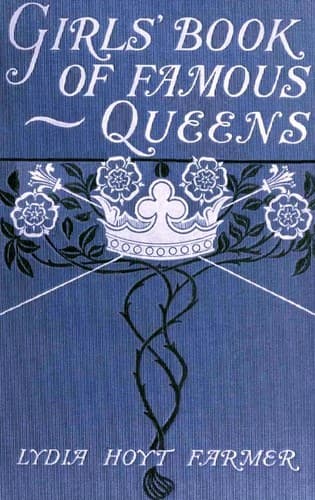
The Girls' Book of Famous QueensFarmer, Lydia Hoyt
History
The Girls' Book of Famous Queens
Farmer, Lydia Hoyt
Queens -- Biography -- Juvenile literature
And what was the woman herself doing in the midst of such stirring
times and brilliant opportunities? Quarrelling with the haughty,
arrogant-willed Duchess of Marlborough; bickering over some contested
point of favoritism; or becoming a puppet in the hands of an ignorant
bedchamber-woman, who ruled the queen because this politic but petty
Mrs. Masham knew enough to hold her tongue when her royal mistress
desired to rave against her overbearing Duchess of Marlborough; and
because Mrs. Masham was smart enough to use her little stock of brains
in scheming to entrap the favor of the wily politicians who courted her
smiles because her ignorant but keen cunning had gained the friendship
of the queen.
Observing such a state of things, it is little wonder that the
quick-witted Addison flashed the scintillating sparks of his keen humor
all over the pages of his famous “Spectator papers,” which appeared at
that time.
Great Britain had been for some time divided into two strong parties,
known as the Whigs and Tories. The Tories held that the rights of kings
were divine, while the Whigs contended a king ruled for the good of his
subjects, and that by illegal or oppressive acts he forfeited his right
to reign, and could be justifiably dethroned by his people. The Tories
upheld the English Protestant church, but detested the Presbyterians
and Dissenters, while they feared the Roman Catholics; while the Whigs
maintained that the Reformed religion being the religion of the state,
a Roman Catholic could not lawfully be placed at its head. There was
also a third party, called the Jacobites, who were more violent Tories,
being partisans of the deposed James II., who, on account of his Roman
Catholic principles, which caused him to entertain certain designs
against the religion and liberty of the state, had been obliged to fly
from England upon the appearance of his Protestant son-in-law, William,
Prince of Orange, who had invaded England at the head of an army, and
been placed by the English people upon the throne in conjunction with
his wife Mary, the eldest daughter of James II., who had been educated
a Protestant.
Public-domain text, read in full here on John Shaqi.
Reviews
Reviews
No reviews yet
Be the first to share your thoughts on this work.
Elsewhere in the archive
Join the Discussion
Join the discussion
Sign in to leave a comment or review.
Sign InorCreate an account