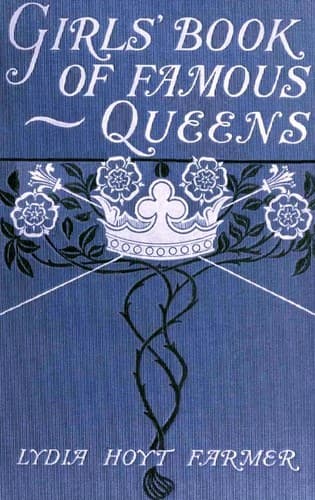
The Girls' Book of Famous QueensFarmer, Lydia Hoyt
History
The Girls' Book of Famous Queens
Farmer, Lydia Hoyt
Queens -- Biography -- Juvenile literature
Notwithstanding the benefit to the country arising from the accession
of the Protestant William and Mary to the throne in place of the
Catholic James II., the unfilial plottings and intrigues of the
princesses Mary and Anne, abetted by their husbands, William, Prince
of Orange, and George, Duke of Denmark, against the indulgent and
kind-hearted James II., their father, was outrageous and dastardly.
Looking at the kingdom, it was well that James II. was dethroned, and
that his Catholic son, called the “Pretender,” the half-brother of Mary
and Anne, was forever debarred from gaining his ancestral rights of
succession; but looking at the side of the treatment which King James
received at the hands of his daughters, upon whom he had lavished every
indulgent kindness, the treacherous scheming, which in the course of
events resulted in vast benefits to England and to Europe, have at the
same time forever covered the names of the children of James II. with
the stigma of most contemptible and unfeeling and wicked ingratitude.
James II. having been deposed, William and Mary of Orange ascended the
throne of England, and William is to be commended for several wise
measures, and England was much the gainer by her change of masters;
but his usurpation, which is called in history the “Revolution,” is
somewhat to be questioned upon the grounds of justice. That it was
highly beneficial no Protestant can for a moment doubt; that the change
of government caused by the celebrated act of Parliament called the
“Bill of Rights,” which raised William and Mary to the throne, to be
succeeded by the Princess Anne, and in case Anne died without heirs,
that the right should then descend to the Electress of Hanover, which
succession afterwards brought in the Protestant Georges of Hanover in
place of the Catholic House of Stuarts,—that a revolution which caused
this change of government was beneficial to England and the world, is
not to be underestimated. This extraordinary but bloodless revolution
occurred in 1688, just one hundred years before the bloody and terrible
French Revolution of 1789. But leaving political questions and turning
to the personal history of the Princess Anne, we find her engaged in an
ignoble squabble with her sister, the Queen Mary, over the allowance
which shall be allotted to the maintenance of the household of the
Princess Anne. The princess had schemed with her sister Mary and the
Prince of Orange to dethrone their father; and now that Mary is queen,
Anne finds her allowance given by her indulgent father cut off, and in
being treacherous to her father she has only worsted her own condition.
So disgraceful was this sisterly quarrel, augmented by the haughty Lady
Churchill (now the Countess of Marlborough), who fomented the disputes
between the sisters, that at last the king and queen were forced to
make a compromise with Anne, and allow the princess £50,000 a year.
As Lord and Lady Marlborough were known to be enthusiastic partisans
Public-domain text, read in full here on John Shaqi.
Reviews
Reviews
No reviews yet
Be the first to share your thoughts on this work.
Elsewhere in the archive
Join the Discussion
Join the discussion
Sign in to leave a comment or review.
Sign InorCreate an account